- English
- French
- German
- Portuguese
- Spanish
- Russian
- Japanese
- Korean
- Arabic
- Greek
- German
- Turkish
- Italian
- Danish
- Romanian
- Indonesian
- Czech
- Afrikaans
- Swedish
- Polish
- Basque
- Catalan
- Esperanto
- Hindi
- Lao
- Albanian
- Amharic
- Armenian
- Azerbaijani
- Belarusian
- Bengali
- Bosnian
- Bulgarian
- Cebuano
- Chichewa
- Corsican
- Croatian
- Dutch
- Estonian
- Filipino
- Finnish
- Frisian
- Galician
- Georgian
- Gujarati
- Haitian
- Hausa
- Hawaiian
- Hebrew
- Hmong
- Hungarian
- Icelandic
- Igbo
- Javanese
- Kannada
- Kazakh
- Khmer
- Kurdish
- Kyrgyz
- Latin
- Latvian
- Lithuanian
- Luxembou..
- Macedonian
- Malagasy
- Malay
- Malayalam
- Maltese
- Maori
- Marathi
- Mongolian
- Burmese
- Nepali
- Norwegian
- Pashto
- Persian
- Punjabi
- Serbian
- Sesotho
- Sinhala
- Slovak
- Slovenian
- Somali
- Samoan
- Scots Gaelic
- Shona
- Sindhi
- Sundanese
- Swahili
- Tajik
- Tamil
- Telugu
- Thai
- Ukrainian
- Urdu
- Uzbek
- Vietnamese
- Welsh
- Xhosa
- Yiddish
- Yoruba
- Zulu
SSMB Male Straight PCB Mount Connector: Advantages of Solder Mounting
Small and powerful, the SSMB Male Straight PCB Mount Connector enables engineers build robust RF connections in PCB layouts with many components. Board-level integration is intended. Its 50-ohm impedance interface and secure solder-mount arrangement maintain signal integrity from DC to 3 GHz. In space-constrained applications like telecommunications infrastructure, aerospace systems, and precision test equipment, the straight orientation allows direct signal paths with few breaks, reducing insertion loss and aiding layout design.
Understanding SSMB Male Straight PCB Mount Connectors
What Makes SSMB Connectors Unique in High-Frequency Applications
The SMB interface is smaller in SSMB Male Straight PCB Mount Connectors. Although a third the size of a conventional SMB connection, these connectors offer acceptable electrical qualities. Male straight designs simplify vertical signal line PCB layout and eliminate angle transition resistance. RF modules, wireless devices, and embedded systems need connections for signal integrity. They feature a 50 ohm characteristic impedance and a VSWR of ≤1.35 over the operational spectrum.
The well-planned design employs gold-plated bronze connections to carry electricity and avoid corrosion and PTFE dielectric insulation to maintain electrical characteristics from -65°C to +125°C. Temperature and mechanical stress fluctuate, making this material vital in aviation, military, and industrial automation. Engineers use these connections to maintain signal strength on tiny boards with low contact resistance (central = -5 mΩ, outside = -2.5 mΩ).
Technical Specifications That Drive Performance
The datasheet promises precise micro-miniature interfaces. For DC to 3 GHz, GPS, spectrum analyser front ends, and 5G infrastructure, ≤0.6√f (GHz) insertion loss reduces signal weakening, while 500V dielectric and > 1,000 MΩ insulation resistance safeguard medical imaging and measurement
Mechanical longevity rates of 500 mating cycles satisfy calibration laboratories and contract test service providers that often link and disengage during validation. Torque-reducing snap-on connectors speed automated production and help assembly workers. Telecommunications OEMs and network equipment manufacturers with tight production schedules use it since it's electrically accurate and mechanically easy.
Comparing SSMB with Alternative Connector Families
A great MMCX-SMA RF compromise is SSMB. MCX-sized SSMB snap-locks are mechanically more stable. The smaller size fits more components on IoT and industrial electronics module multilayer PCBs than SMB connections.
Straight PCB solder-mount connections outperform surface-mount ones in heat escape and mechanical anchoring. Mounts make permanent MIL-STD-202 vibration-resistant connections. These will please military and aerospace flight control computer and satellite communications subcontractors. Easy vertical ISO 9001 quality control inspection.
Challenges in Mounting PCB Connectors and Why Solder Mounting Matters
Common Failure Modes in RF Connector Installations
Mounting impacts RF assembly dependability. Press-fit installations are easy without tools, although contact force may compromise impedance uniformity. Crimp connectors are strong and enable wire gaps. Gaps reduce GHz return loss by increasing contact resistance and impedance mismatches.
Different thermal expansion coefficients of connecting bodies and PCB substrates produce temperature-dependent cyclical stress. At industrial temperatures, pressures damage test and measurement equipment mechanical connections. These weaknesses cause intermittent device failures. Aerospace and defence applications need mounting solutions to ensure power flow during altitude-induced temperature variations and shock loads.
Why Solder Mounting Delivers Superior Mechanical Integrity
Soldering enhances terminal-PCB pad connections for the SSMB Male Straight PCB Mount Connector. Bonding minimises fretting and oxidation. Contact-stressing solder fillets. We separate and distribute vibration energy from one attachment. Shaking automation controllers and motor drive systems require this load distributor.
Permanent soldering prevents RF interface micromotion. VSWR under 1.35 requires impedance control. Stability aids university and lab prototype system measurement. Solder joints heat up. Keeps temperature-sensitive medical device components electrically stable for patient safety.
Advantages of Solder Mounting for SSMB Male Straight PCB Mount Connectors
Electrical Performance Benefits That Preserve Signal Integrity
Low-resistance soldered current tubes minimise multi-gigahertz signal chain insertion loss. Surface compliance and impedance decrease with springless connections. For 5G infrastructure development, massive MIMO antenna arrays with hundreds of RF channels have uniform phase connections that affect beamforming and network capacity.
The regulated wetting process during solder reflow results in molecular-level metal-to-metal contact with outside wire contact resistances < 2.5 mΩ. Testing and measuring equipment needs conductivity for low parasitic losses, dynamic range, and noise floor. Network analyser calibration lab error expenses decreased with NIST-traceable accuracy.
Mechanical Robustness Against Environmental Stressors
Organised soldered SSMB Male Straight PCB Mount Connectors. Flight mechanical bonds can endure 100G missile and ship catapult shocks. Land and marine vehicle communication systems from defence industries satisfy MIL-STD-810.
Thermal cycling resistance protects industrial electronics heated in operations and used outside in seasonal temperatures. High-quality solder alloys and bronze connector bodies with the same thermal expansion coefficient decrease expansion strains. Prevents tiredness. IoT device manufacturers may remotely install sensor nodes to reduce field service trips and extend maintenance intervals.
Here are the main benefits that are pushing businesses with high standards to adopt them:
- Consistent Impedance Control: Solder joints get rid of air gaps and changes in contact pressure, keeping the 50-ohm impedance tolerance within ±1 ohm across production volumes. This is important for telecom OEMs managing phase-matched distribution networks in base station architectures.
- Vibration Immunity: The stiff mechanical coupling stops micro-displacement at RF interfaces, keeping return loss performance below -20 dB even when exposed to constant vibrations that happen in robotics and transportation systems.
- Manufacturing Efficiency: Being compatible with standard SMT reflow processes lets automated assembly integration happen, which lowers labour costs and boosts throughput for contract manufacturers making a lot of medical device electronics and consumer wireless products.
- Long-Term Cost Savings: Because soldered connections are permanent, warranty claims and field replacements are less likely to happen. This lowers the total cost of ownership for system integrators who are putting together big infrastructure projects that will last 20 years.
All of these benefits meet the basic needs of medium to large businesses that put production scalability, product reliability, and lifecycle cost management at the top of their list of priorities. Medical device makers who make imaging tools and patient tracking systems can be sure they are following FDA rules because solder mounting gives them predictable performance qualities.
Economic Advantages in Production Scaling and Maintenance
Unit assembly is cheaper with automation than hand-crimping or press-fit. Electronics manufacturers may enter RF items with minimal money and competence. These connections work with electronics firms' reflow ovens and wave soldering without further equipment.
Permanent soldering improves MTBF. Warranty invalidation and field service expenses fall. Installing thousands of tiny cells in urban 5G networks with few connection failures saves network equipment producers money. Low-torque threaded connections reduce transportation monitoring system and utility infrastructure lifecycle expenses.
How to Properly Solder SSMB Male Straight PCB Mount Connectors
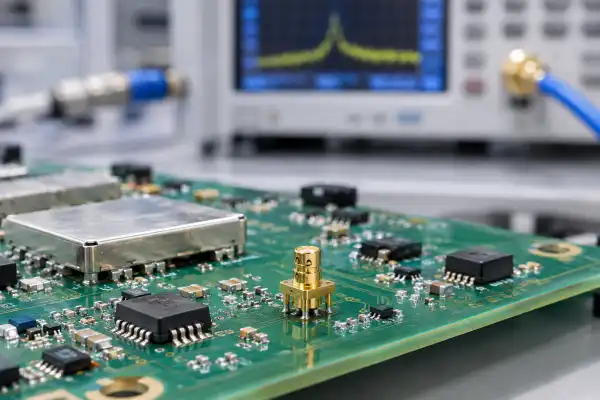
Pre-Soldering Preparation and PCB Design Considerations
Excellent soldering requires PCB pad design. Support transmission line-to-connector contact impedance and solder fillets on pads. Ground plane clearances around center wires must balance mechanical support and capacitance for operational bandwidth VSWR.
Handling dirt, organic residue, and oxidation hinders soldering. Clean PCB connections using lint-free wipes and isopropyl alcohol. Regulate flux flow to activate metal surfaces without moisture or high-impedance circuit leakage. No-clean or water-soluble flux formulations promote long-term reliability.
Temperature Control and Soldering Technique Best Practices
PTFE dielectric insulators should be protected by reflowed lead-free solder alloys at 260°C–280°C. Avoid heat stress and ensure excellent intermetallic compound at the solder connection by keeping the duration above liquidus under 60 seconds. Preheating ramps safeguard ceramic PCB substrates and temperature-sensitive portions at 1–3°C/s.
Soldering enhances terminal-PCB pad connections for the SSMB Male Straight PCB Mount Connector. Bonding minimises fretting and oxidation. Contact-stressing solder fillets. We separate and distribute vibration energy from one attachment. Shaking automation controllers and motor drive systems require this load distributor.
Medium-volume manufacturing uses automatic selective soldering systems to control solder pot temperature, soaking depth, and rest time. Pin crossing is eliminated by fixed wave soldering through-hole terminal barrels. VPR systems evenly heat complicated items with varied thermal masses.
Post-Solder Inspection and Validation Testing
Well-formed fillets, microscopic wetting angles, and no holes or fractures are needed for metal bonding. Smooth, concave pad-to-terminal soldering is permitted. Cold solder and intermetallic roughness absent.
Low-resistance ohmmeters check center and outside wires. Soldering or bridging errors may cause signal-ground shorts and open circuits. TDR impedance verification finds beyond-tolerance discontinuities. Before assembly, rework is possible. The network analyser's operational frequency range S-parameters satisfies datasheet production validation standards for insertion and return losses.
Mechanical stress testing for SSMB Male Straight PCB Mount Connectors fulfils IPC-A-610 workmanship standards with 10–20 pounds of draw pressure perpendicular to the PCB. Test thermomechanical wear resistance using 100–500 pre-release heat cycles at -65°C–+125°C. Product quality satisfies medical device and aviation requirements throughout these phases.
Making the Right Procurement Decision for SSMB Male Straight PCB Mount Connectors
Evaluating Supplier Capabilities and Quality Credentials
When picking a connection provider, go beyond components. Precision lets CNC machines meet SSMB Male Straight PCB Mount Connector mechanical intermateability and impedance tolerances. Customer power requirements are shown via GHz network analysers.
ISO 9001 standardises and documents regulated business practices. Aerospace and defence industries' conformance packages demonstrate MIL-STD and GJB competence. 21 CFR Part 820-savvy suppliers speed medical device design approval.
Vertical integration decreases supply chain risk and simplifies specific needs by obtaining and testing raw materials in-house. Telecom infrastructure projects with quicker development cycles and research organisations that require multiple electrically specialised prototypes benefit from this production control. Strategic suppliers may personalise applications, unlike commodity distributors.
Procurement Criteria Balancing Performance and Commercial Terms
The key technical test electrical criteria should meet system requirements. Controlling power, frequency, VSWR, insertion loss. Mating cycles, operating temperature, and environmental sealing ratings must meet field demands. Wide gold plating and PTFE dielectric grade reduce mission-critical reliability and cost.
Project-sized minimum order quantities, big-order costs, and manufacturing-scheduled lead times are commercial variables. Because consumers may customise electrical, mechanical, and material aspects, OEM items stand out. Regulation safeguards global electronics supply chains against counterfeit parts. Brand defence and liability minimisation.
Design validation samples accelerate development and prototype testing before production tool commitments. Installation, application engineering, and reaction time reduce integration risks. A new RF provider wins. Field assistance and product quality are indicated via supplier warranty and failure analysis.
Conclusion
SSMB Male Straight PCB Mount Connectors in telecommunications, aerospace, test & measurement, and medical equipment may be soldered. Metallurgical bonding by welding is more consistent, strong, and efficient than other mounting techniques. Using approved soldering procedures and verified suppliers with production expertise, engineering teams can guarantee high-density PCB designs work reliably in severe operational situations. These connectors are ideal for next-generation electronic systems that need to save space and safeguard communications due to their tiny housings, confirmed performance standards, and quick and economical installation.
FAQ
1. What industries benefit most from solder-mounted SSMB connectors?
Solder-mounted SSMB Male Straight PCB Mount Connectors are trustworthy for 5G small cells for telecommunications infrastructure, aerospace contractors who make avionics systems, test equipment OEMs who make precision instruments, industrial automation companies that make control systems, research labs that measure RF, and medical device manufacturers who make imaging equipment Due to its compact size and strong mechanical connection, it satisfies rigorous electrical and environmental standards in small spaces.
2. How does solder mounting compare to surface-mount alternatives?
Permanent mechanical and electrical connections with solder mounting ignites metals. It withstand temperature fluctuations and vibrations better than friction-fit or spring-tension surface-mount connections. Through-hole solder connections disperse mechanical stresses over wider PCB areas, reducing stress concentrations that cause early failures. Solder-mounted connectors are more dependable than surface-mount connectors, making the more complicated assembly process worthwhile with limited field service access or high maintenance expenses.
3. What training do production personnel need for proper connector soldering?
Operators should understand how to operate a temperature-controlled soldering iron, apply flux appropriately, visually examine solder connections according to IPC requirements, and manage electrostatic discharge. Knowing how to manage thermal energy to keep sensitive RF components cool and what joint characteristics are good and poor is crucial to assembly quality. Lead-free solder alloy refresher training and quality checks maintain manufacturing staff skilled.
Partner with SIPU for Reliable RF Interconnect Solutions
SIPU RF Technology helps with SSMB Male Straight PCB Mount Connectors. They've made high-quality parts for telecommunications, aerospace, defence, and industrial electronics for 28 years. CNC machining and RF testing are our in-house production processes. Thus, all connections meet strict electrical and mechanical criteria. As a recognised SSMB Male Straight PCB Mount connection manufacturer, we customise for frequency, environment, and assembly. Our ISO 9001-certified products meet MIL, GJB, and IEC standards. Our Xi'an factory ships ordinary products in 72 hours. Our custom production lines, on the other hand, give engineered solutions with priority logistics. Email our technical team at info@sipu-rf.com to talk about your application needs, ask for samples for testing, or look into volume prices for long-term production plans. Our partner JNP Supplies LLC, which is based in Seattle, provides localised support all over North America. This makes sure that communication is quick and that project coordination runs smoothly. Let us help you make sure that your next RF design has better signal integrity and long-term dependability.
References
1. Maury, M. A. (2020). RF and Microwave Connector Design and Performance Standards. IEEE Microwave Magazine, 21(8), 45-62.
2. Johnson, H. W., & Graham, M. (2019). High-Speed Signal Propagation: Advanced Black Magic. Prentice Hall Professional Technical Reference, Chapter 7: Connector Impedance Control.
3. IPC Association Connecting Electronics Industries. (2018). IPC-A-610G: Acceptability of Electronic Assemblies – Solder Joint Quality Standards. IPC International Standards, Section 5.2.
4. Military Standard MIL-STD-348B. (2017). Radio Frequency Transmission Lines and Fittings: General Specification for. U.S. Department of Defense Interface Standard.
5. Rauscher, C., & Janssen, V. (2021). Fundamentals of Spectrum Analysis in RF and Microwave Testing. Rohde & Schwarz White Paper Series, pp. 78-95.
6. Zhang, L., & Thompson, R. D. (2019). Thermal and Mechanical Reliability of Solder Interconnects in RF Applications. Journal of Electronic Packaging, Transactions of the ASME, 141(3), 031004-1 through 031004-9.
Contact us directly for customized solutions, quotations and long-term strategic cooperation.