- English
- French
- German
- Portuguese
- Spanish
- Russian
- Japanese
- Korean
- Arabic
- Greek
- German
- Turkish
- Italian
- Danish
- Romanian
- Indonesian
- Czech
- Afrikaans
- Swedish
- Polish
- Basque
- Catalan
- Esperanto
- Hindi
- Lao
- Albanian
- Amharic
- Armenian
- Azerbaijani
- Belarusian
- Bengali
- Bosnian
- Bulgarian
- Cebuano
- Chichewa
- Corsican
- Croatian
- Dutch
- Estonian
- Filipino
- Finnish
- Frisian
- Galician
- Georgian
- Gujarati
- Haitian
- Hausa
- Hawaiian
- Hebrew
- Hmong
- Hungarian
- Icelandic
- Igbo
- Javanese
- Kannada
- Kazakh
- Khmer
- Kurdish
- Kyrgyz
- Latin
- Latvian
- Lithuanian
- Luxembou..
- Macedonian
- Malagasy
- Malay
- Malayalam
- Maltese
- Maori
- Marathi
- Mongolian
- Burmese
- Nepali
- Norwegian
- Pashto
- Persian
- Punjabi
- Serbian
- Sesotho
- Sinhala
- Slovak
- Slovenian
- Somali
- Samoan
- Scots Gaelic
- Shona
- Sindhi
- Sundanese
- Swahili
- Tajik
- Tamil
- Telugu
- Thai
- Ukrainian
- Urdu
- Uzbek
- Vietnamese
- Welsh
- Xhosa
- Yiddish
- Yoruba
- Zulu
How to Choose the Best SMP Female Right Angle Connector for RG405
When choosing an SMP Female Right Angle Connector for RG405, consider electrical performance and mechanical compatibility. In test equipment, aviation, and telecommunications, 50-ohm subminiature push-on connections can withstand 26.5 GHz frequencies. Right-angle designs maximise space and signal integrity in tiny assemblies. VSWR, insertion loss, mating cycles, and environmental resistance should be assessed by procurement specialists to ensure connection durability in demanding RF systems.
Understanding SMP Female Right Angle Connectors for RG405
For signal integrity, radar, satellite, and automated test equipment utilise 0.086-inch RG405 semi-rigid coaxial cable. Small locations seldom employ SMP Female Right Angle Connector for RG405.
What Makes SMP Connectors Unique in RF Applications
Military and aerospace modular RF blind-mating requires snap-on SMP and torque for SMA and 2.92 mm threads. This program creates and deletes stacked connections while others struggle. Connecting 50-ohm microwaves with male bullet and female interface.
RF wire is right-angle vertical. The connecting body signal line rotates 90 degrees, reducing board layouts and assembly height. CNC-machined SIPU connections retain impedance as they flex. The exterior and central conductors of golden-plated beryllium bronze are corrosion-resistant from -65°C to +125°C.
Electrical Characteristics That Define Performance
RF experiments and communications utilise 50 ohms. Wire form and dielectric gap affect SMP female right-angle impedance. VSWR matches transmission line (1.1 + 0.02F(GHz)). Low-VSWR boosts power and reduces reflection. PAA installations with hundreds of connections need this.
Poor contact signals indicate insertion loss. An insertion loss of ≤0.07√F(GHz) dB at 26.5 GHz suggests a limit below 0.36 dB. Multi-stage RF chains in 5G base stations and satellite transponders benefit from low-loss. Outdoor and unpressurised aeroplane cabins benefit from PTFE dielectric material's weather resistance and temperature stability.
Core Criteria to Consider When Choosing the Best SMP Female Right Angle Connector for RG405
Consider technical requirements, cost, and delivery time when choosing an RF connection like the SMP Female Right Angle Connector for RG405. Systematic assessment may help engineers find the best solutions and avoid expensive specification mismatches. Consider these operational factors for the best RG405 SMP Female Right Angle Connector.
Frequency Range and Bandwidth Requirements
Application determines frequency. A 5G big MIMO antenna system in the 3.5 GHz band needs different connections than a 20 GHz Ka-band satellite ground station. Many SMP interfaces support 26.5 GHz. Some manufacturers make 40 GHz variations with tighter dimensions and better transition geometry.
Accepting failures and understanding your system's maximum frequency may improve connections. Test and measurement connections must accept frequencies higher than the equipment being tested to enable harmonic measurements and remove unwanted signals. Connection frequency must be 20% higher than maximum operating frequency for VSWR and insertion loss.
Mechanical Durability and Mating Cycle Life
Its interface mate cycle limits connect-disconnects before failure. For transitory connections like module-to-module interconnections in phased array radar systems, ≥500 cycles are recommended. Test fixtures and calibration labs that swap wires during measurements require quicker cycles.
Detent choices effect cycle life and holding force. Full detent prevents military vehicle and aircraft vibrations with maximum pull-off force. Reduce multi-switch matrix blind-mate with smooth bores. Mid-limit simplifies bench testing. Due to stress, vibration, and temperature cycling, MIL-STD-202 connecting surfaces require strength.
Material Selection and Environmental Resistance
Beryllium bronze springs hold contact pressure better than brass or phosphor bronze following heat and joining. By adding gold to contact surfaces, corrosion is prevented and resistance is reduced to ≤6.0 mΩ for core wires and ≤2.0 mΩ for outer connections. Low resistance transmits DC and RF signals by lowering ohmic losses.
Current leakage between conductors is controlled by 5,000 MΩ insulating resistance. Low-noise amplifier inputs and precision measurement systems require this. 500V RF-resistant dielectrics. Humidity, salt, and fungus hinder tropical marine radar.
Comparing SMP Female Right Angle Connectors for RG405: Market Options and Alternatives
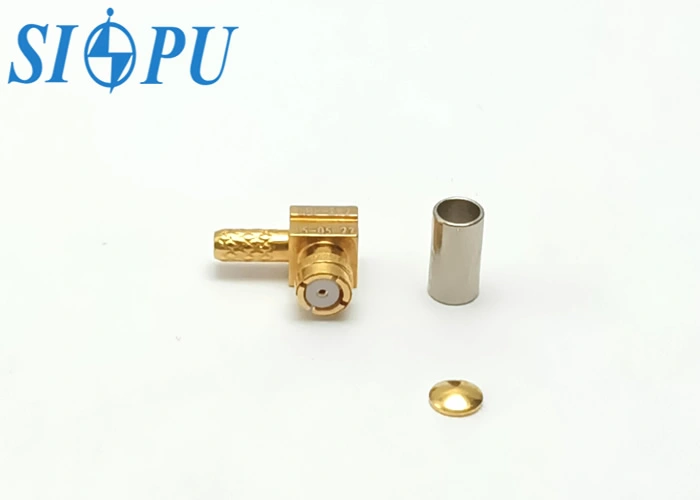
Famous firms have made RF links for decades, while experts create new ones. The SMP Female Right Angle Connector for RG405 enables procurement teams choose where to purchase.
Leading Manufacturers and Their Product Lines
Few smp adapter manufacturers globally. Defence enterprises that require extensive testing and traceability may obtain MIL-STD-348-compliant Amphenol products. Choose TE Connectivity for telecom infrastructure projects with thousands of automated units and testing.
SIMU RF Technology has produced reliable military hardware for 28 years. Without distributors, Simu provides factory-direct costs. Xi'an, Seattle's JNP Supplies LLC certifies MIL, GJB. Assurance of quality. Advanced manufacturing creates unique items rapidly, and technical assistance is accessible within 12 hours.
Pasternack's large inventory and same-day basic installations meet urgent test equipment needs. Factory-direct wire and coating maker SIPU offers huge discounts.
Functional Alternatives and Interface Comparisons
Threaded coupling and bigger diameters simplify field SMB connection installation without blind-mate. High-density boards with threaded connections reduce vibrations but limit vertical space. Overthreaded retention streamlines SMP setup and saves space.
Compact 65 GHz SMPM connections. Automatic 5G mmWave radar. RG405 cable with a lower diameter may need assembly. Need 0.047-inch semi-rigid wires.
System design determines interface gender. Feminine PCB/equipment panel border safeguards center connections. Bullet contacts and end wires are protected by stored male connectors. All connections can pair, although hermaphroditic ones restrict frequency.
How to Procure SMP Female Right Angle Connectors for RG405 Efficiently
Technical needs, price limits, and supply chain risk management all need to be balanced for buying to work well. Lead times are cut down and product quality meets application needs with a structured approach for procuring the SMP Female Right Angle Connector for RG405.
Defining Your Order Requirements
Single-piece purchases aid prototype and proof-of-concept development when requirements change. Most providers simplify impedance and frequency using common designs. Discounts rise for 100–10,000 products. SIPU provides free standard supplies within 72 hours for urgent repair.
When OTC fails, special orders are needed. Specialist equipment may require a wider frequency range, harsh environment coatings, or different mechanical specs. Procurement-supplier engineering technology offers customisation. Quotes faster with cable type, frequency range, working conditions, and quality. SIPU engineers have unique development skills after 28 years of product manufacture. Designers build or remodel.
Evaluating Supplier Credentials and Capabilities
Manufacturing quality certificates. The ISO 9001 certification demonstrates systematic quality management, whereas AS9100 for aviation and ISO 13485 for medical products show competence. Request certificates and examine the certifying body's accreditation utilising independent databases.
Inspections of electrical components reassure consumers. Find companies with big RF test facilities that measure VSWR, insertion loss, return loss, and other properties at various frequencies. SIPU employs precision device and national-standard vector network analysers. Test results are in all packages.
For risk management, supply chain transparency important. In-house or outsourced manufacturing allows suppliers examine quality and transport dependability. The vertically integrated SIPU complex includes CNC machining, assembly lines, cable termination tools, and testing labs. Integration streamlines design modifications and eliminates suppliers.
Negotiation Strategies for Long-Term Value
Supplier interactions, not contracts. Suppliers provide process development and technical support beyond unit cost. Forecasts help suppliers arrange raw materials and production. Multiple methods may cut expenses and enhance output.
Payment terms affect cash. Net 30/60 for long-term accounts. Deposits or letters of credit may be needed for new accounts. Electronic payments like PayPal and wire transfers are faster than cheques. Explain warranty, refund, and specification ranges.
Sample and prototype applications provide real-world input before bulk manufacturing. Designers evaluate mechanical, electrical, and assembly in real systems using SIPU samples. Manufacturing in batches lowers specification concerns.
Installation and Maintenance Best Practices for SMP Female Right Angle Connectors on RG405
The performance of the SMP Female Right Angle Connector for RG405 is maintained and early failure is avoided by using the right fitting methods. Even high-quality parts break down quickly if they are handled or put together incorrectly.
Step-by-Step Installation Process
The cable is prepared by cutting RG405 to the proper length using a tubing cutter to achieve square, burr-free ends. Avoid hacksaws and abrasive wheels, which may damage the outside conductor and introduce metal particles. The outside conductor should be stripped to the connection assembly design size, generally 0.080 to 0.100 inches. The central conductor requires little stripping to disclose enough copper for the connection contact.
Slide the connector body over the ready wire end and solder the center and outside leads to make a connection. Soldering station temperature should be 343°C (650°F) for lead-free solder. For lead-filled solder, heat to 316°C (600°F). Apply flux to the cable and connection before heating. Warm the junction until solder flows smoothly and covers the surface. Too much solder may bridge wires or create impedance gaps.
Check for flux dust, good solder filleting, and proper center wire protrusion after assembly. The middle pin should be flush with the connection face. Under magnification, cold solder junctions, contaminants, and mechanical damage are visible. VSWR and insertion loss must be tested electrically using a vector network analyser before installing the device.
Common Installation Pitfalls and Prevention
Misalignment during mating is the most common reason why connectors break. SMP interfaces can handle axial misalignment from 0 to 0.010 inches and radial misalignment up to ±0.020 inches. However, if these limits are crossed, contacts can become deformed or dielectric insulators can crack. When putting together links in blind-mate arrangements, use alignment supports or guide pins. When joining, slowly apply force along the axis of the connection. Do not load from the side, as this can bend the pins.
For push-on SMP connectors, overtightening does not matter, but too much force during engagement can damage detent mechanisms or squeeze dielectric spacers. When the interface is locked properly, it should engage with a clear snap or click. If the resistance goes up while mating, stop and check both connectors for dirt, damage, or misalignment.
Electrical function is lowered and wear happens faster when dust, oils, or metal bits get into it. Plug connectors away in bags or caps that keep them safe when not in use. You should use isopropyl alcohol and lint-free swabs to clean the mating areas before each link. When you touch gold-plated contacts with your bare hands, the oils on your skin make them more resistant to rust.
Maintenance Protocols for Extended Service Life
The application environment and mating frequency determine routine inspection frequency. In temperature-controlled laboratories, tabletop test equipment may only require annual inspection. However, field systems exposed to severe temperatures and vibrations should be evaluated every three months. Cracked insulators, broken contacts, and improperly installed connection bodies should be checked. The entrance force should remain constant throughout the cycle. More force may indicate dirt or contact wear.
A network analyser detects electrical deterioration before it occurs. Compare the current measurements to the baseline data from system setup. If the VSWR or insertion loss increases by more than 0.1 dB, the connection has to be changed since performance is declining. Sometimes intermittent connections cause readings to vary when the cable is moved or the temperature changes.
Replacement is essential when mating cycles exceed limitations or examination finds damage. Track connection application in test instruments and calibration systems with high cycle counts. Keeping key system replacement parts on hand reduces anticipated maintenance downtime. SIPU stocks typical configurations to satisfy orders promptly and avoid significant lead times that might compromise operational plans.
Conclusion
To choose the best SMP Female Right Angle Connector for RG405 cable, you have to balance the electrical performance requirements with the mechanical durability and cost factors. Technical selection is based on knowing the frequency needs, VSWR limits, and environmental conditions. Reliable sourcing is based on evaluating suppliers based on quality standards, manufacturing capabilities, and service timeliness. The performance of a connector is maintained for as long as it is used by following the right installation and maintenance procedures. The small right-angle shape saves room in dense RF assemblies without affecting the integrity of the signal, making these connections very useful in aircraft, defense, telecommunications, and test measurement.
FAQ
1. How does a right angle SMP connector differ from a straight version in electrical performance?
Both configurations keep the 50-ohm impedance and work with the same frequency ranges, which in standard designs is up to 26.5 GHz. Because the internal transition shape is 90 degrees, the right-angle form may have a slightly higher VSWR at the highest frequencies. Differences in insertion loss are very small, usually less than 0.05 dB. The mechanical configuration is mostly chosen based on available space and how the cables need to be routed, not on how well it works electrically.
2. Can SMP female right angle connectors work with flexible equivalents to RG405 cable?
Yes, these connectors can fit cables with a diameter of 0.086 inches. This includes SS405 semi-rigid cables that can be bent by hand and some low-loss flexible cables with the right outer diameter. Depending on how the wire is made, the electrical performance may be a little different. Check that the impedance is consistent and look at the cable manufacturer's specs to make sure they are compatible. Most of the time, flexible cables have higher insertion loss than semi-rigid types, but they are easier to install in situations with complicated routing.
3. What determines whether Full Detent or Smooth Bore is better for my application?
Full Detent gives the strongest retention force, making it good for places with a lot of vibration, like airplanes and military vehicles, where connections need to be able to withstand mechanical stress. Smooth Bore lowers the engagement force, which makes blind-mate setups easier for situations where more than one link needs to be made at the same time or where mating rounds need to happen often. For benchtop test equipment, Limited Detent provides a moderate level of retention. When choosing a locking style, you should think about the surroundings, how often the parts go together, and how easy it is to get to the assembly.
Partner with SIPU RF Technology for Superior SMP Connector Solutions
Precision-engineered SMP Female Right Angle Connector for RG405 solutions are made by SIPU RF Technology using military-grade manufacturing methods and providing quick support around the world. We offer competitive factory-direct prices and reliable 72-hour shipping on standard goods because we are an experienced producer with 28 years of production experience. Our ISO 9001-certified facility has separate production lines for custom development. We also have full RF testing tools to make sure that every connector meets the strict requirements. During the whole buying process, our engineering team is there to help you with technical questions and application support, whether you need trial samples, large quantities, or custom solutions for unique uses. Get in touch with info@sipu-rf.com right away to talk about your needs with a reliable supplier and get detailed quotes that are made just for your project.
References
1. Rizzi, P. A. (1988). Microwave Engineering: Passive Circuits. Prentice Hall.
2. Pozar, D. M. (2011). Microwave Engineering, 4th Edition. John Wiley & Sons.
3. MIL-STD-348A (1991). Military Standard: Connectors, Radio Frequency, General Specification for. United States Department of Defense.
4. Johnson, H., & Graham, M. (2003). High-Speed Signal Propagation: Advanced Black Magic. Prentice Hall.
5. Montrose, M. I., & Nakauchi, E. M. (2004). Testing for EMC Compliance: Approaches and Techniques. IEEE Press.
6. Gore, W. L. (2019). Microwave Cable Assemblies Design Guide. W. L. Gore & Associates Technical Publications.
Contact us directly for customized solutions, quotations and long-term strategic cooperation.