- English
- French
- German
- Portuguese
- Spanish
- Russian
- Japanese
- Korean
- Arabic
- Greek
- German
- Turkish
- Italian
- Danish
- Romanian
- Indonesian
- Czech
- Afrikaans
- Swedish
- Polish
- Basque
- Catalan
- Esperanto
- Hindi
- Lao
- Albanian
- Amharic
- Armenian
- Azerbaijani
- Belarusian
- Bengali
- Bosnian
- Bulgarian
- Cebuano
- Chichewa
- Corsican
- Croatian
- Dutch
- Estonian
- Filipino
- Finnish
- Frisian
- Galician
- Georgian
- Gujarati
- Haitian
- Hausa
- Hawaiian
- Hebrew
- Hmong
- Hungarian
- Icelandic
- Igbo
- Javanese
- Kannada
- Kazakh
- Khmer
- Kurdish
- Kyrgyz
- Latin
- Latvian
- Lithuanian
- Luxembou..
- Macedonian
- Malagasy
- Malay
- Malayalam
- Maltese
- Maori
- Marathi
- Mongolian
- Burmese
- Nepali
- Norwegian
- Pashto
- Persian
- Punjabi
- Serbian
- Sesotho
- Sinhala
- Slovak
- Slovenian
- Somali
- Samoan
- Scots Gaelic
- Shona
- Sindhi
- Sundanese
- Swahili
- Tajik
- Tamil
- Telugu
- Thai
- Ukrainian
- Urdu
- Uzbek
- Vietnamese
- Welsh
- Xhosa
- Yiddish
- Yoruba
- Zulu
How Gold-Plated Contacts Benefit SMA Female Right Angle Connectors
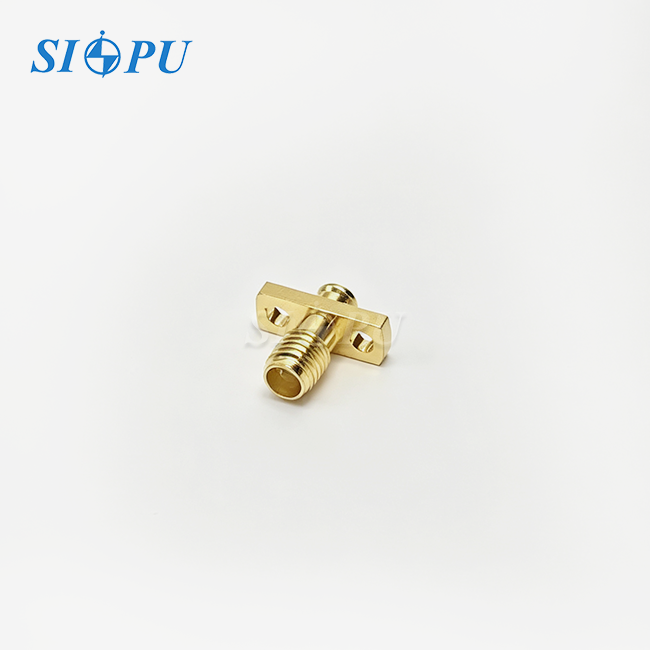
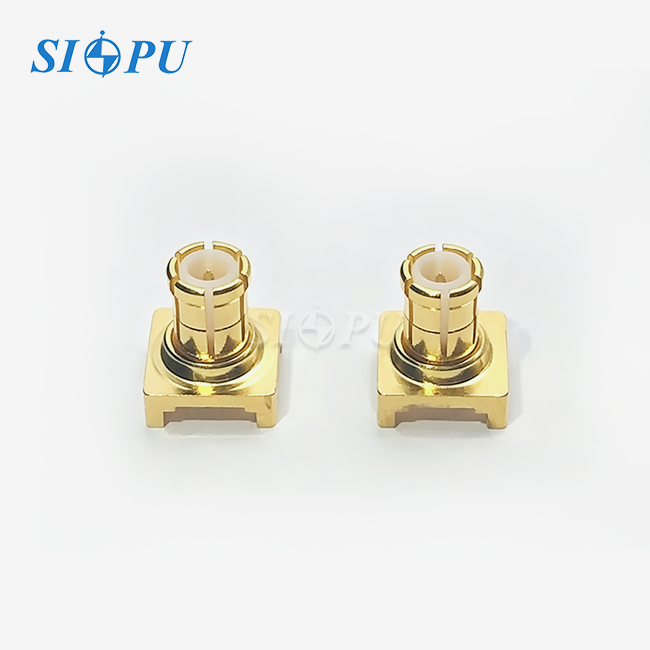
Gold-plated contacts in an SMA female right angle connector directly improve signal integrity, corrosion resistance, and mechanical longevity. The gold layer eliminates oxidation on contact surfaces, keeping contact resistance below 3.0 mΩ even after hundreds of mating cycles. For RF engineers working across DC–12.4 GHz in 5G base stations, BBU boards, or AAU RF links, this means stable 50 Ω impedance matching, lower VSWR, and fewer field failures. When board space is limited and cable routing demands a 90-degree turn, the right-angle form factor combined with gold plating delivers both physical and electrical advantages that standard finishes simply cannot match.
Understanding SMA Female Right Angle Connectors and Gold-Plated Contacts
What the Right-Angle Form Factor Solves
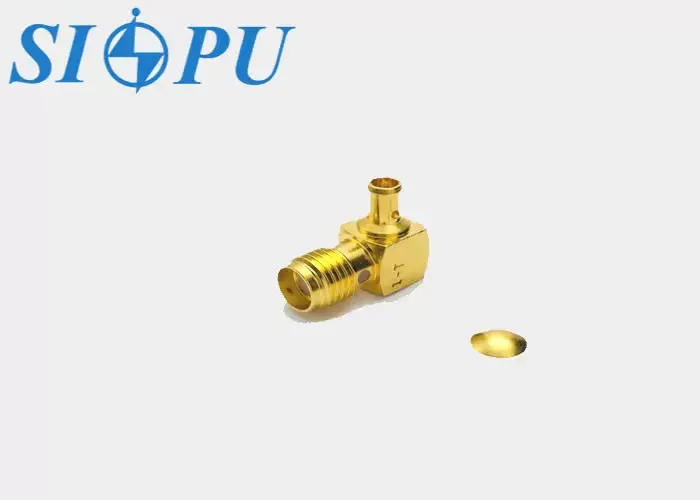
At the PCB or panel contact, a right-angle SMA connection changes the path of a coaxial signal by 90 degrees. This shape gets rid of the problem of minimum bend radius that straight connections cause in small spaces. The connection makes the turn instead of pushing the wire into a tight arc that puts stress on the dielectric. This means that there is less mechanical stress on the solder joints and better wire handling in high-density chassis.
Core Specifications That Matter
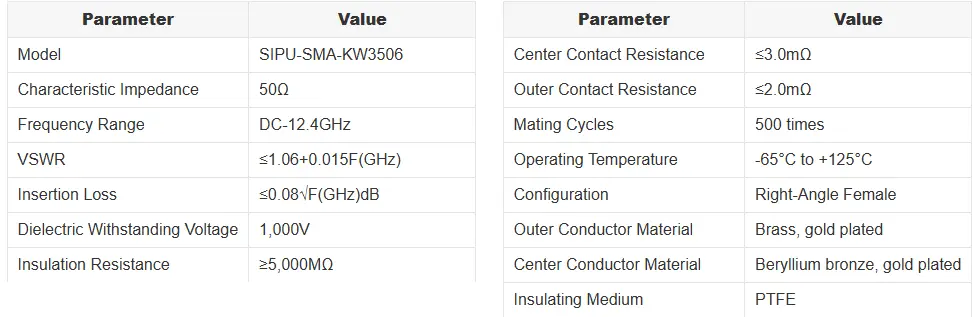
The SIPU-SMA-KW3506 works from DC to 12.4 GHz and has a typical impedance of 50 Ω. The VSWR stays at ≒1.06+0.015F(GHz), and the insertion loss stays at ≒0.08√F(GHz) dB. The two main standards for SMA connections are IEC 61169-15 and MIL-STD-348, and these numbers are in line with them. The connector has an insulation resistance of more than 5,000 MΩ and a dielectric voltage of 1,000 V.
Why Gold Is the Contact Material of Choice
Gold doesn't oxidize at the molecular level because it is at the bottom of the list of electrochemically reactive substances. A thin layer of gold, about 0.76 µm to 1.27 µm thick on RF connectors, keeps the contact surfaces free of an oxide film that would raise the resistance and spread the signal if it was there. Gold finishes have lower contact resistance across a wider temperature range than tin or nickel ones. This is important when working between -65 °C and +125 °C.
Key Advantages of Gold-Plated Contacts in SMA Female Right Angle Connectors
Stable Electrical Performance Across Frequency
It is possible to predict resistance losses because both the brass outer wire and the beryllium bronze center contact are plated with gold. There is a 3.0 mΩ resistance in the center of the SIPU-SMA-KW3506 and a 2.0 mΩ resistance in the outer contact. Even a small rise in contact resistance can mess up test results for PLL intermodulation testing or phase-noise measurements on 5G NR radio boards. Gold gets rid of that variable.
Corrosion Protection in Harsh Environments
Outdoor 5G small cells, rooftop BBU boxes, and industrial ports all have RF equipment that has to deal with changes in temperature, humidity, and salt mist. The ASTM B117 salt spray test works much better on gold finishing than on silver or tin. The PTFE dielectric makes this stronger by blocking the absorption of moisture, which keeps the air-line geometry stable over the life of the connector.
Extended Mating Cycle Life
The SIPU-SMA-KW3506 can connect and disconnect 500 times. Because gold is hard and beryllium bronze springs back, the center contact keeps its shape even after being inserted many times. This stability is important for test engineers who use network analyzers or signal generators that join and disconnect a lot. It's hard to tell the difference between a real device fault and impedance discontinuities caused by a worn or deformed contact.
So, gold-plated contacts in a right-angle RF connector take care of three engineering issues at once: maintaining a clean signal, making the connector last in harsh environments, and making sure the same thing works every time. These aren't just marketing claims; they come straight from the properties of gold and the measurements of the connection.
Comparing Gold-Plated SMA Female Right Angle Connectors with Other Connector Types
Right-Angle vs. Straight SMA
A SMA female right angle connector comes out of the PCB perpendicular to the board plane. This works well as long as there is enough space for the cable. One type comes out at a right angle and runs parallel to the board, cutting the frame depth by the length of the connection. This difference can show if the design is possible for AAU board-end RF lines where the radome limits the depth.
SMA vs. BNC in High-Frequency Applications
Most standards say that BNC connections can only handle 4 GHz, so they can't be used for 5G sub-6 GHz or mmWave backhaul. IEC 61169-15 says that SMA connectors can handle 12.4 GHz or higher, depending on the type. SMA is the right choice for test tools that works across the whole DC–12.4 GHz band. BNC is still only useful for baseband or lower-frequency video and control signals.
Cost and Value Comparison
Gold-plated SMA connectors cost a little more than nickel-plated ones. Gold plating, on the other hand, pays for itself very quickly when engineers look at the total cost of ownership, which includes field replacement labor, downtime, and failed prototype tests. When a connector oxidizes and fails a PLL intermodulation test, it can cost an engineer more time than a whole batch of gold-plated alternatives.
Practical Considerations for Purchasing Gold-Plated SMA Female Right Angle Connectors
Technical Specification Checklist
Before placing an order, procurement engineers should confirm frequency range alignment, VSWR budget against system margin, cable compatibility (the SIPU-SMA-KW3506 matches CXN3506 cable), and operating temperature range. Plating thickness should appear on the product datasheet; any supplier unable to provide this figure is a procurement risk.
Here are the core selection criteria worth verifying before SMA female right angle connector supplier qualification:
- Frequency range: Confirm the connector covers your full operating band without VSWR budget violations.
- Plating specification: Request documented gold thickness (µm) and base material (brass outer, beryllium bronze center) as part of incoming inspection criteria.
- Compliance certificates: RoHS, REACH, IEC, CE, and UL documents should accompany each production lot for regulatory traceability.
- Cable interface match: Mismatched cable-to-connector geometry creates an impedance step that degrades return loss regardless of plating quality.
These criteria, when applied consistently, protect engineering teams from batch-to-batch variation that delays prototype validation and volume production sign-off.
Supplier Qualification and Quality Assurance
SIPU's manufacturing process includes CNC-machined tolerances, 100% plating thickness inspection using XRF, and dielectric withstanding voltage testing on every production batch. ISO 9001 certification governs process consistency. For engineers worried about specification drift between the sample lot and production lot — a common concern in RF procurement — this level of documented process control provides a concrete audit trail.
Case Studies and Real-World Applications
5G Infrastructure Deployment
When an OEM was making remote radio units for a 5G small-cell program, they switched out nickel-plated SMA connectors on the board-end RF link for gold-plated right-angle versions. After 1,000 hours of going from -40 °C to +85 °C, the gold-plated links' VSWR didn't change in a way that could be measured. The nickel-plated samples had 15% more contact resistance, which was enough to make the system noise level go above the link budget margin.
Industrial Automation Gateway
For an embedded ruggedized gateway to work in a chemical processing plant, it needed antenna connectors that could handle being cleaned and changing temperatures all the time. According to SIPU's stated standard, gold-plated right-angle SMA connectors kept their insulation resistance above 5,000 MΩ after being exposed to salt spray for 96 hours. Over the course of 18 months, the facility's maintenance team said that no replacements were needed for connectors.
These two examples show that gold plating is not just an extra feature; it has a direct effect on how reliable something is in the field and how confident buyers are in the purchase.
Conclusion
With gold-plated connections, a mechanical part can be turned into a precise RF link. When engineers choose connectors for 5G base stations, BBU assemblies, test tools, or aircraft boards, the material they use on the contact surface impacts the stability of the VSWR, the consistency of the insertion loss, and the service life. All of these features are built into the SIPU-SMA-KW3506, which is a 90-degree, 50 Ω, DC–12.4 GHz SMA female right angle connector. It has been manufactured for more than 25 years and meets all RoHS, REACH, IEC, CE, and UL standards. When making a choice about where to buy something that needs both prototype samples and mass production quickly, the safer option is to work with a provider that offers documented process control.
FAQ
1. Does gold plating affect VSWR at higher frequencies?
Gold plating doesn't change VSWR much on its own. The main things that determine VSWR are the shape and size of the connectors. The SIPU-SMA-KW3506 has a VSWR of ≤1.06+0.015F(GHz) thanks to precise CNC machining. Gold plating keeps the contact quality and doesn't change the impedance profile.
2. How thick should the gold plating be on an SMA connector?
Over a nickel barrier layer, the gold finishing on RF connections is usually between 0.76 µm and 1.27 µm thick. Gold that is thinner is cheaper, but it may wear out faster in high-cycle uses.
3. Is this connector compatible with standard SMA male counterparts?
Yes. The SIPU-SMA-KW3506 meets the dimensions required by IEC 61169-15 and MIL-STD-348, so it can be used with any other SMA male connection that also meets those standards. There's no need for an adapter.
4. What cable should be used with this connector?
This connector is made to work with CXN3506 cable. Using a cable diameter that isn't compatible creates a mechanical gap at the crimp or solder interface, which causes an impedance discontinuity no matter how well the plating is done.
5. How do I verify plating quality on incoming lots?
XRF (X-ray fluorescence) analysis confirms the thickness of gold without damaging it. Surface flaws can be seen when the object is magnified. For every shipping lot, ask for a Certificate of Conformance and a metal inspection report.
Request a Sample from SIPU — Your Trusted SMA Female Right Angle Connector Manufacturer
Since more than 25 years ago, SIPU RF Technology has sold gold-plated RF connectors to telecom OEMs, aerospace integrators, and test equipment makers. The SIPU-SMA-KW3506 is made on in-house SMA female right angle connector lines and comes with full paperwork, short-cycle sampling, and the ability to change the amount. To get a datasheet, prototype sample, or bulk quote, please email our engineering team at info@sipu-rf.com or visit sipuconn.com.
References
1. IEC 61169-15: Radio-Frequency Connectors — Part 15: Sectional Specification for SMA Connectors. International Electrotechnical Commission, 2013.
2. MIL-STD-348B: Interface Standard for Radio Frequency Connector Interfaces for MIL-PRF-39012. U.S. Department of Defense, 2010.
3. Ramo, S., Whinnery, J. R., & Van Duzer, T. Fields and Waves in Communication Electronics. John Wiley & Sons, 1994.
4. Pozar, D. M. Microwave Engineering, 4th ed. John Wiley & Sons, 2012.
5. ASTM B117: Standard Practice for Operating Salt Spray (Fog) Apparatus. ASTM International, 2019.
6. Harper, C. A. Electronic Packaging and Interconnection Handbook, 4th ed. McGraw-Hill, 2004.
Contact us directly for customized solutions, quotations and long-term strategic cooperation.