- English
- French
- German
- Portuguese
- Spanish
- Russian
- Japanese
- Korean
- Arabic
- Greek
- German
- Turkish
- Italian
- Danish
- Romanian
- Indonesian
- Czech
- Afrikaans
- Swedish
- Polish
- Basque
- Catalan
- Esperanto
- Hindi
- Lao
- Albanian
- Amharic
- Armenian
- Azerbaijani
- Belarusian
- Bengali
- Bosnian
- Bulgarian
- Cebuano
- Chichewa
- Corsican
- Croatian
- Dutch
- Estonian
- Filipino
- Finnish
- Frisian
- Galician
- Georgian
- Gujarati
- Haitian
- Hausa
- Hawaiian
- Hebrew
- Hmong
- Hungarian
- Icelandic
- Igbo
- Javanese
- Kannada
- Kazakh
- Khmer
- Kurdish
- Kyrgyz
- Latin
- Latvian
- Lithuanian
- Luxembou..
- Macedonian
- Malagasy
- Malay
- Malayalam
- Maltese
- Maori
- Marathi
- Mongolian
- Burmese
- Nepali
- Norwegian
- Pashto
- Persian
- Punjabi
- Serbian
- Sesotho
- Sinhala
- Slovak
- Slovenian
- Somali
- Samoan
- Scots Gaelic
- Shona
- Sindhi
- Sundanese
- Swahili
- Tajik
- Tamil
- Telugu
- Thai
- Ukrainian
- Urdu
- Uzbek
- Vietnamese
- Welsh
- Xhosa
- Yiddish
- Yoruba
- Zulu
SMP Connectors: Full Detent vs Limited Detent vs Smooth Bore
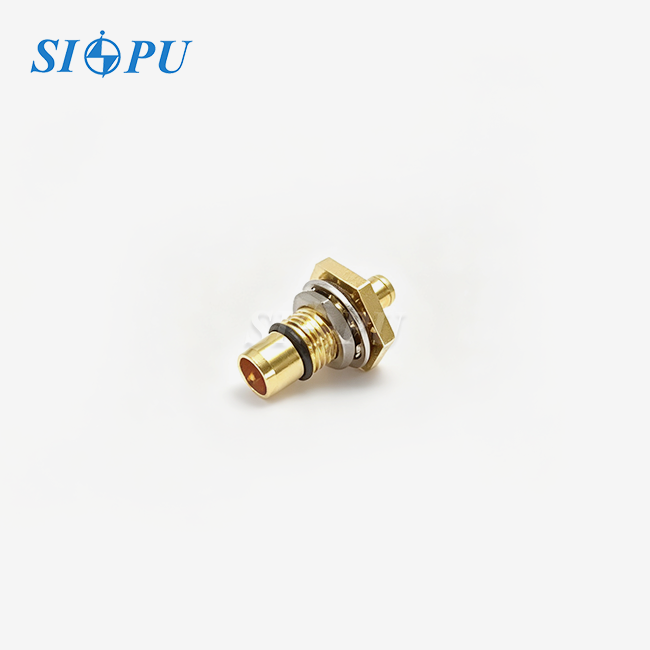
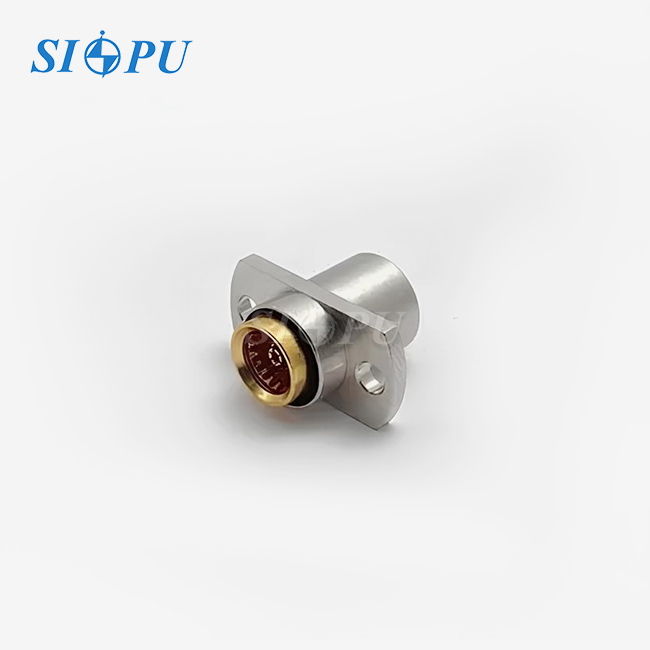
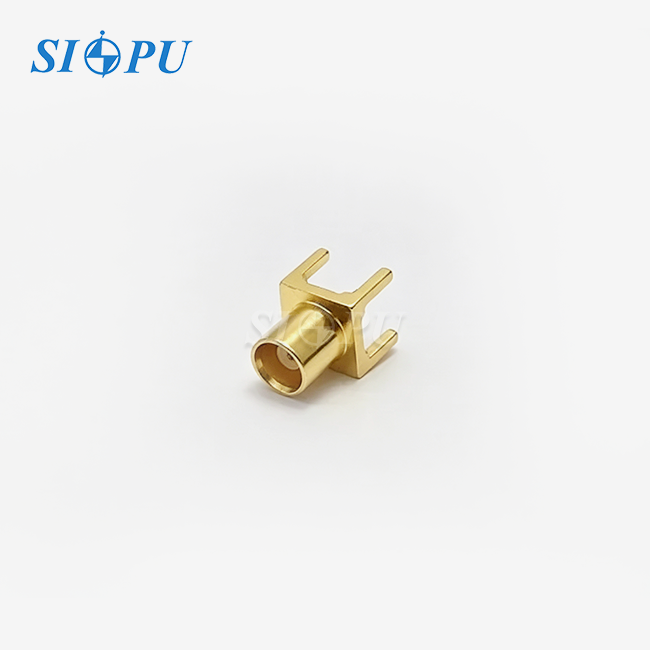
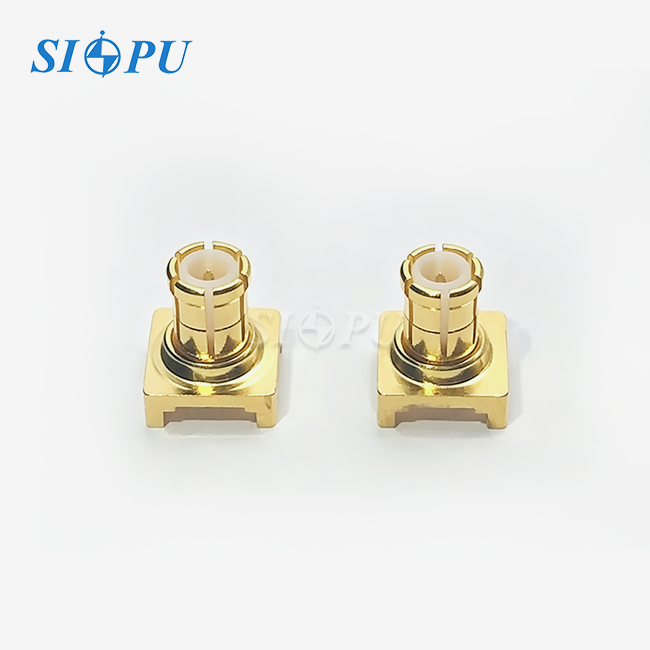
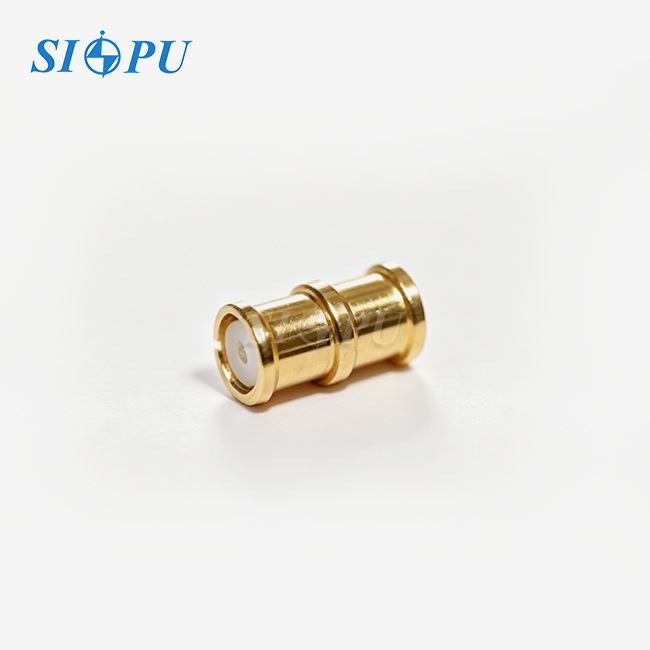
When engineers spec an RF connector for a board-level phased array or radar module, the retention mechanism often decides system reliability. SMP connectors split into three mechanical families — Full Detent, Limited Detent, and Smooth Bore — and choosing the wrong one can push VSWR above spec or make field service a nightmare. The SMP male limited detent PCB mount connector sits at the center of this decision: it handles DC to 40 GHz, mates blind, and releases by hand, making it the go-to choice for 5G AAU boards, radar front-ends, and automated test fixtures alike.
Understanding SMP Connector Types and Their Features
What Makes SMP Connectors Different
SMP (Sub-Miniature Push-on) ports are push-on connectors with a characteristic impedance of 50 Ω and can tolerate frequencies up to 40 GHz. Unlike threaded connections, SMP connectors have a compact outer diameter of about 3.5 mm, allowing engineers to install multiple RF connections within a limited PCB area. All three methods of retention have the same base shape, but a varied groove depth is carved into the female receptacle. The depth of this groove has a direct influence on the amount of effort needed to engage and disengage the connection.
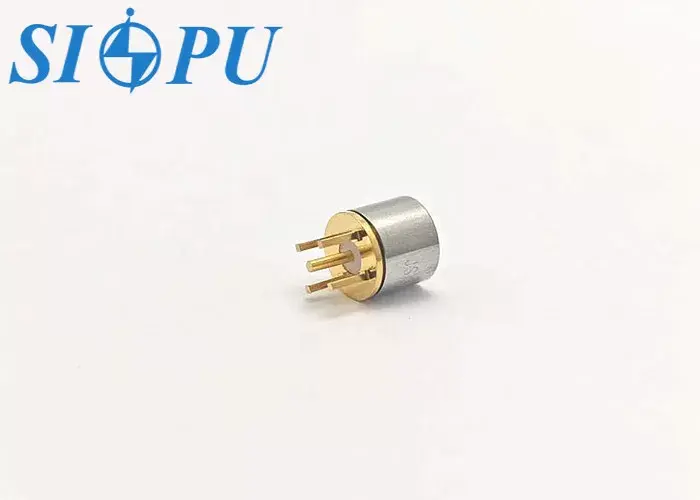
Full Detent, Limited Detent, and Smooth Bore at a Glance
A deep slot in Full Detent locks the matched pair securely; you usually need a removal tool to get it off. Smooth Bore doesn't have any grooves at all. The interface only relies on frictional contact, so it comes loose with very little pull force. The SMP male limited detent PCB mount connector is in the middle. It has a shallow groove that holds it in place well enough to withstand mild shock and shaking while still letting go easily by hand or with a flathead tool.
Technical Specs That Procurement Teams Must Verify
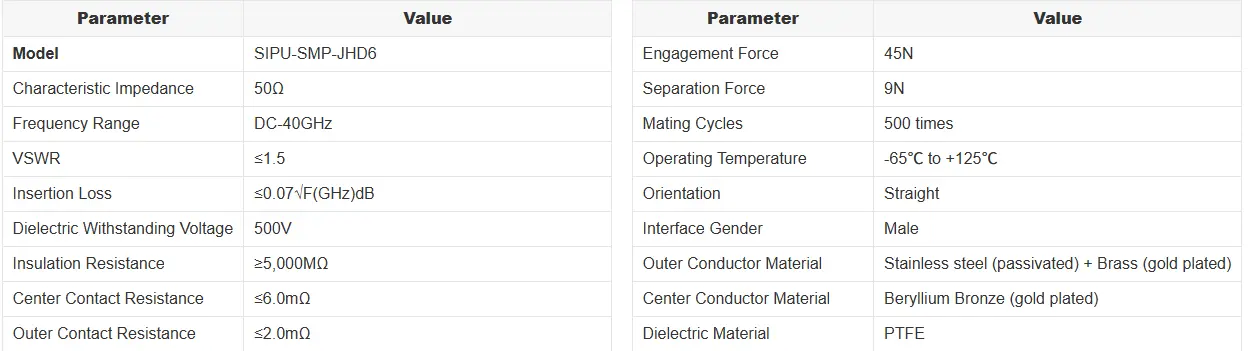
Before you purchase any SMP push-on connection, you should know the frequency ceiling, VSWR, engagement force, and dielectric material. The impedance should be 50 ohms. Especially for the SIPU-SMP-JHD6 restricted detent version, VSWR is ≤1.5, insertion loss is ≤0.07√F(GHz) dB, engagement force is 45 N, separation force is 9 N, insulation resistance is ≥5,000 MΩ, and operating temperature range is −65 °C to +125 °C. You can ascertain from these figures whether the part fits a 40 GHz phased array or a tabletop device.
Comparative Analysis: Full Detent vs Limited Detent vs Smooth Bore SMP Connectors
Mechanical Performance Differences
The three versions are shown in simple language below:
- Full Detent — Deep groove, engagement ≈ 90 N, separation ≈ 45 N, requires extraction tool, best for airborne and naval platforms where vibration is severe and boards are rarely swapped.
- Limited Detent — Shallow groove, engagement ≈ 45 N, separation ≈ 9 N, hand-releasable, rated for 500 mating cycles; the SMP male limited detent PCB mount connector is the standard choice for 5G base stations and radar OEM modules where boards need periodic replacement.
- Smooth Bore — No groove, minimal retention, disconnects with a light pull, suited for low-vibration test benches or applications where the mated pair is held captive by a housing rather than by contact force.
Before finalizing a bill of materials, the next step is to make sure that the retention level matches the actual operating environment. This is because these mechanical differences have a direct effect on application fit.
Electrical Performance and VSWR Considerations
All three can hit 40 GHz, but the accuracy of the cutting is more important than the depth of the groove for signal quality. Over its whole range, the SIPU-SMP-JHD6 has a VSWR of less than 1.5, which is good enough for most 5G and radar bands. There are other limited locking designs that cost more and say the VSWR is ≤1.10 + 0.01f(GHz). Find out about different insertion loss curves and ask for a measured S-parameter file before you choose a source for a link above 30 GHz.
Buyer Decision Framework
The choice should be based on size limitations, mating cycle needs, and field service standards. For phased array OEMs that change boards once a month during integration, the SMP male limited detent PCB mount connector cuts down on maintenance time compared to full detent without the risk to the signal path that comes with smooth bore. Also, procurement teams should compare supplier lead time to project milestones. For example, when time is of the essence for a prototype, a 72-hour standard delivery window may be more important than a small unit price difference.
How SMP Male Limited Detent PCB Mount Connectors Work — Installation and Best Practices
The Limited Detent Retention Mechanism
When fully inserted, the shallow groove on the female jack snaps over the bead on the male pin, making a click sound and providing satisfying tactile feedback. The 9 N separation force means that the SMP male limited detent PCB mount connector can be disengaged with relatively little manual force, reducing the risk of excessive PCB flex or pad lift during board swaps. The 45 N engagement force is strong enough to hold the connector in place through normal handling shock.
PCB Layout and Soldering Best Practices
For solder joints to work, the gold-plated beryllium bronze center contacts and passivated stainless steel housings need clean, oxide-free pads. When putting it together, do these things:
- Use the manufacturer's recommended pad dimensions; oversized pads increase parasitic capacitance and degrade VSWR at high frequency.
- Apply flux sparingly to avoid wicking into the PTFE dielectric.
- For lead-free reflow, the PTFE insulator on the SIPU-SMP-JHD6 withstands peak temperatures of approximately 260 °C without dimensional change.
- Inspect solder fillets under magnification before board-level RF testing; a cold joint at the outer conductor produces a discontinuity visible on a TDR trace.
If you follow these steps, you'll be able to get consistent first-pass yields and avoid having to do extra work that raises the cost per unit.
Common Installation Errors and Troubleshooting
Axial imbalance is the most common source of increased VSWR post-placement. Before you run any board-level testing, check that the PCB standoff height is proper. Just 0.1 mm of additional air between the male and female reference planes can increase reactive impedance and cause signal reflections. A TDR (Time Domain Reflectometry) sweep is a fast way to locate the position of the discontinuity. The Limited Detent SMP interface has a radial tolerance of ±0.5 mm. That means the panel cutouts and guide pins on backplanes must be designed to accommodate this alignment tolerance.
Procurement Insights: Choosing and Buying SMP Male Limited Detent PCB Mount Connectors
Supplier Selection Criteria
Some big connector makers, like Amphenol, Rosenberger, and TE Connectivity, only make a few detent SMP lines. For SKUs that aren't in stock, Western wholesalers can have wait times of up to 16 weeks. SIPU was established in 1998 and is certified by ISO 9001. They carry standard SMP variants that can be delivered within 72 hours and can also make custom mechanical envelopes using dedicated CNC production lines. When OEMs do engineering builds every three months, the ability to make things quickly and easily is often more important than brand loyalty.
Verifying Product Authenticity and Quality
Before you approve a new supplier, make sure you get a Certificate of Conformance and a report on the thickness of the gold plating (XRF measurement, usually ≥1.27 µm / 50 micro-inches per MIL-G-45204). As a minimum, each batch of dielectric must pass a 500 V voltage test and an insulation resistance test of at least 5,000 MΩ. SIPU includes paperwork showing that their products are RoHS-compliant with every production run. This documentation can help facilitate customs clearance for international shipments. Procurement teams should also verify the applicable export-control classification, including whether ECCN 3A001.b applies to the specific product, based on its technical characteristics.
Pricing, MOQ, and Lead Time Strategy
SIPU offers mixed-sample orders for standard SMP male limited detent PCB mount connector units. This lets engineering teams see how different configurations work before they buy a lot of them. Even though the MOQ is fixed, you can make a lot of something if you want to. The company also protects OEM-specific footprints with an NDA. You should plan your purchase timeline around an approval window of 3 to 6 months, which includes getting samples, testing them on an RF bench, doing a small-batch trial, and then releasing the full batch.
Advantages and Applications of SMP Limited Detent Connectors in Modern B2B Markets
Why the Limited Detent Design Suits High-Density Boards
They have a low-profile PCB solder-mount body that makes the SMP male limited detent PCB mount connector work with tile-array plans where the space between connectors can get short of 5 mm. Contacts that are gold-plated don't oxidize even after thousands of heat cycles, so the center conductor's contact resistance stays below 6.0 mΩ. In phased array beam-steering circuits, where inter-element amplitude and phase mismatch lowers antenna gain, that uniformity is important.
Here are the main areas of use where this connector makes a real difference:
- 5G AAU and Phased Array Boards — Blind-mate capability simplifies module stacking in active antenna units; moderate retention holds position through transport shock without preventing field board replacement.
- Military Radar and EW Systems — The passivated stainless steel housing and BeCu center contact maintain electrical performance from −65 °C to +125 °C, meeting GJB and MIL environmental standards for airborne and naval platforms.
- Automated Test Equipment — Semiconductor ATE load boards experience hundreds of mating cycles per day; limited detent reduces fatigue on the female receptacle compared to full detent, extending fixture service life.
All of these use cases need the same thing: a signal that works reliably at microwave frequencies and the ability to access the connection mechanically for regular repair and maintenance.
Market Trends Driving SMP Adoption
As 5G mmWave technology advances and AESA radar systems become smaller, OEMs are being pushed to put more connectors into increasingly compact assemblies. The SMP limited detent format and precise CNC machining to tolerances of less than 10 µm can handle both trends without having to redesign the connector for each generation. SIPU's production lines can be used for both commercial telecom and defense programs. This means that procurement teams only need to deal with one source to get everything from engineering samples to over 10 million RMB worth of products every year.
Conclusion
Choosing between Full Detent, Limited Detent, and Smooth Bore comes down to three questions: How severe is the vibration environment? How often will the connector be cycled? And what VSWR budget does the link allow? The SMP male limited detent PCB mount connector answers all three for most 5G and radar OEM programs — firm enough to hold during shock, gentle enough to release by hand, and machined precisely enough to stay within a VSWR ≤1.5 budget from DC to 40 GHz. For procurement teams comparing original and alternative sources, SIPU's ISO 9001 production and 72-hour standard delivery offer a practical path from engineering sample to volume supply.
FAQ
1. What is the main difference between Limited Detent and Full Detent SMP connectors?
Limited Detent uses a shallow groove, producing engagement and separation forces low enough for hand operation. Full Detent uses a deep groove that maximizes vibration resistance but typically requires a removal tool. For most board-level RF assemblies, limited detent balances retention with serviceability.
2. Can an SMP limited detent connector support blind-mating?
Yes. The push-on geometry with radial float tolerance of ±0.5 mm makes the SMP male limited detent PCB mount connector well suited for modular backplanes where visual alignment is not possible during insertion.
3. What is the typical minimum order quantity and lead time?
SIPU ships standard SMP connector variants within 72 hours. Mixed sample orders are supported for qualification builds, and production MOQs are negotiable based on annual volume commitment.
4. How do I verify gold plating quality before approving a batch?
Request an XRF plating thickness report confirming ≥50 micro-inches of gold per MIL-G-45204, along with a Certificate of Conformance and dielectric withstanding voltage test data at 500 V.
5. Does the PTFE dielectric hold up through lead-free reflow?
Yes. PTFE retains its dimensional and electrical properties at peak reflow temperatures around 260 °C, making it compatible with standard lead-free solder profiles used in automated PCB assembly.
Request a Quote for SIPU SMP Male Limited Detent PCB Mount Connectors
Looking for a reliable SMP Male Limited Detent PCB Mount Connector for high-frequency RF and microwave applications? SIPU RF Technology Co., Ltd. combines nearly three decades of RF connector manufacturing experience with precision CNC machining, advanced production capabilities, and rigorous quality control to deliver dependable interconnect solutions. Our SMP Male Limited Detent PCB Mount Connector features a 50Ω impedance, DC–40 GHz operating frequency, gold-plated contacts, and a self-locking push-in design, providing a practical balance between connection retention and convenient disconnection. With ISO 9001 quality management, MIL, GJB, and IEC standard-based manufacturing capabilities, and flexible OEM/ODM customization, SIPU supports demanding requirements in aerospace, defense, telecommunications, and automated test equipment. Standard products are available from stock, while customized solutions benefit from dedicated production lines and responsive technical support. Contact our engineering and sales team at info@sipu-rf.com to request product specifications, discuss PCB mounting requirements, or obtain a quotation. Choose SIPU for precision-engineered SMP connectivity and establish a reliable foundation for your next RF project.
References
-
Amphenol RF. SMP Connector Product Catalog. Amphenol RF, 2022.
-
IPC. IPC-7251: Generic Requirements for Through-Hole Design and Land Pattern Standard. IPC, 2021.
-
MIL-PRF-39012. Connectors, Coaxial, Radio Frequency, General Specification for. U.S. Department of Defense, 2020.
-
MIL-STD-202. Test Method Standard: Electronic and Electrical Component Parts. U.S. Department of Defense, 2015.
-
Pozar, David M. Microwave Engineering, 4th ed. Wiley, 2011.
-
Rosenberger. RF Connector Technical Handbook: SMP and SMPM Series. Rosenberger Hochfrequenztechnik, 2023.
Contact us directly for customized solutions, quotations and long-term strategic cooperation.