- English
- French
- German
- Portuguese
- Spanish
- Russian
- Japanese
- Korean
- Arabic
- Greek
- German
- Turkish
- Italian
- Danish
- Romanian
- Indonesian
- Czech
- Afrikaans
- Swedish
- Polish
- Basque
- Catalan
- Esperanto
- Hindi
- Lao
- Albanian
- Amharic
- Armenian
- Azerbaijani
- Belarusian
- Bengali
- Bosnian
- Bulgarian
- Cebuano
- Chichewa
- Corsican
- Croatian
- Dutch
- Estonian
- Filipino
- Finnish
- Frisian
- Galician
- Georgian
- Gujarati
- Haitian
- Hausa
- Hawaiian
- Hebrew
- Hmong
- Hungarian
- Icelandic
- Igbo
- Javanese
- Kannada
- Kazakh
- Khmer
- Kurdish
- Kyrgyz
- Latin
- Latvian
- Lithuanian
- Luxembou..
- Macedonian
- Malagasy
- Malay
- Malayalam
- Maltese
- Maori
- Marathi
- Mongolian
- Burmese
- Nepali
- Norwegian
- Pashto
- Persian
- Punjabi
- Serbian
- Sesotho
- Sinhala
- Slovak
- Slovenian
- Somali
- Samoan
- Scots Gaelic
- Shona
- Sindhi
- Sundanese
- Swahili
- Tajik
- Tamil
- Telugu
- Thai
- Ukrainian
- Urdu
- Uzbek
- Vietnamese
- Welsh
- Xhosa
- Yiddish
- Yoruba
- Zulu
2.92mm Male to 2.4mm Female Gold-Plated Adapter: Buying Tips
The best way to buy a 2.92mm male to 2.4mm female gold-plated adapter is to verify four things before you order: interface fit, VSWR and insertion loss across the full band, contact wear life, and batch-level quality records. A gold finish alone does not prove performance. Ask for the specification over the whole DC-40GHz range, match the mating-cycle rating to your test plan, and compare a sample on your own network analyzer before you commit to volume. I wrote this guide to help you do that with confidence.
What Is a 2.92mm Male to 2.4mm Female Gold-Plated Adapter?
How the Interface Conversion Works?
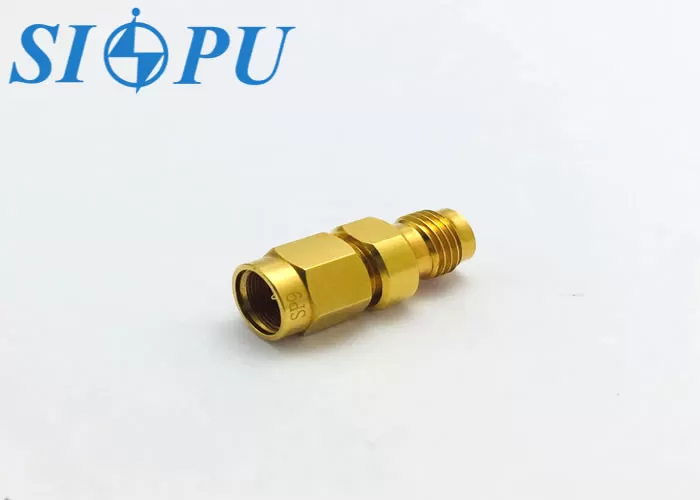
A 2.92mm male to 2.4mm female gold-plated adapter is a good way to connect two coaxial cables. There is a 2.92mm male link on one end, which is also known as the K-type interface. A 2.4mm female connector that meets IEC 61169-40 is on the other end. Both of these screw-coupled 50 Ω interfaces were made for work with millimeter waves. In terms of how they work, the 2.92mm port fits with SMA and 3.5mm plugs but not the 2.4mm port. Even though the two lines look alike, they can't be switched out. With this adapter, a 2.92mm test port can connect to a 2.4mm device or cable without having to make a special bracket. The 2.92mm side is limited to 40 GHz, which means that even when the 2.4mm hardware hits 50 GHz, the pair can still be used.
Where Engineers Use It?
From what I've seen, labs mostly buy this part for mixed-interface benches. It's possible for a vector network tester with 2.92mm ports to need to test a 2.4mm device. To connect to a 5G module, a 2.4mm wire might need to be joined. Antenna research, radar, satellite communications, aircraft, and defense test stations are some of the places where teams use a 2.92mm male to 2.4mm female gold-plated adapter that they buy. The SIPU-2.92/2.4-JK's body is straight and small, so it can fit on dense benches and in RF modules. It also has a high level of vibration resistance for setups that move around a lot.
Why Gold Plating Matters?
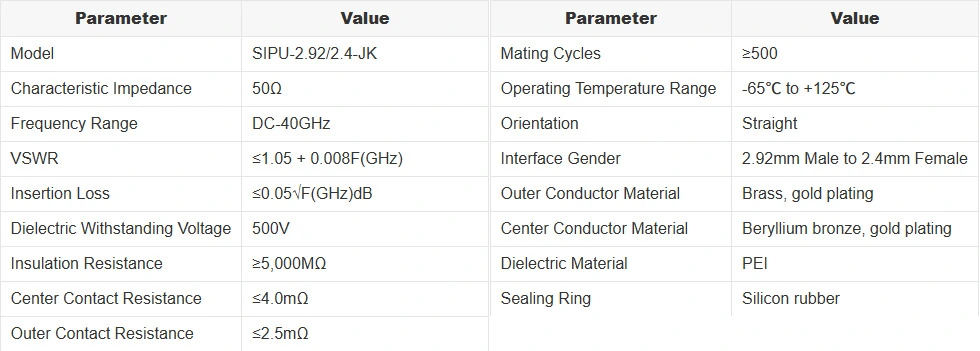
Since gold doesn't oxidize, the resistance of the contact stays the same even after being mated many times. The external wire is made of brass, and the center contact is made of beryllium metal. Both are gold-plated on the SIPU 2.92mm male to 2.4mm female gold-plated adapter. It is required that the contact resistance is no more than 4.0 mΩ in the middle and no more than 2.5 mΩ on the outside. You can choose between plating and base metal. Compare a gold-plated brass adapter to a stainless steel one by looking at the body material, the thickness of the plating, and how well the two stick together. SIPU checks the thickness of the gold treatment and the strength of the bonding by taking samples from groups. That check helps stop the wear and tear on the contacts that messes up high-frequency readings.
Key Specifications to Check Before You Buy
Read the VSWR and Insertion Loss Formulas
The label "40 GHz" doesn't tell you much, so do the math at the frequency you want to test. The 2.92mm male to 2.4mm female gold-plated adapter has a VSWR of ≤1.05 + 0.008F, where F is the frequency in GHz. That lets you get 1.13 at 10 GHz. At 40 GHz, it lets 1.37 pass through, which is the same as a 16-dB return loss. It says that the insertion loss is 0.05√F dB, which is equal to 0.16 dB at 10 GHz and 0.32 dB at 40 GHz. If you measure close to 40 GHz, plan for the higher limits because they go up with frequency. Then check them by running a sample through your own analyzer and seeing if the trace matches the formula before you let them go through with the buy.
Check Materials, Contacts, and Mating Life
A 2.92mm male to 2.4mm female gold-plated adapter wears out first at the center pin. A pin that is worn out can damage a test port or a calibration kit. The center contact of the SIPU-2.92/2.4-JK is made of beryllium bronze, which is known for being a springy material. Both conductors are gold-plated. It has a rating of 500 or more mating cycles. How you handle things affects how they wear, so clean the threads, use the right pressure, and be careful to line up the parts. Track the number of times each unit is used and make a plan for when to replace it if your line mates the adapter a lot during the shift. Ask each provider how thick the metal is and how it will be inspected. "Gold-plated" is not a full answer by itself.
Confirm Temperature, Sealing, and Electrical Limits
This adapter works from -65°C to +125°C and has a PEI dielectric and a silicone rubber closing ring. SIPU says that the PEI qualities stay the same in that temperature range. The materials are important for labs that use thermal chambers or do environmental screening because they change the way impedance works. The electrical limits are an insulator that can handle 500 V and an insulation resistance of at least 5,000 MΩ. SIPU checks both of these on every unit. I recommend a chamber sweep on a sample to compare VSWR at cold, room, and hot points for work that needs to be sensitive to temperature. That lets your metrology team see data from your own setup instead of just a datasheet.
How to Choose the Right Adapter and Avoid Common Mistakes
Start With Your Connection Scenario
Make a list of the ports, cables, calibration kit, fixtures, and free room for your tools. Make sure both ends of the connector are the same gender. A male 2.92mm end needs a female mate. Pick out a spot for the reference plane. Either calibrate with the adapter in the path or remove its response so it doesn't add a mismatch that wasn't there before. Bear in mind how often the operators will connect and disconnect. A 2.92mm male to 2.4mm female gold-plated adapter might work with one bench but not with another. Ask for units from the same production batch if you need matched sets for your project. This way, the electrical behavior will be the same across all benches.
Adapter or Cable Assembly?
When there isn't much room and the signal path needs to stay short, a rigid adapter fits short, direct connections. Cable assemblies are good for setups with misaligned ports, longer reach, or equipment that needs to be protected from strain and vibration. Support heavy fixtures separately if you have a rigid adapter hanging off of an analyzer port. This adds weight and leverage to the connector. Compare the choices based on their space, signal loss, flexibility, and cost of replacement. It's more important to have tight specs and repeated mating for calibration or measurement work than to have the lowest price. However, SIPU also makes phase-stable cable systems and unique interconnects if a cable run works better for your needs.
Mistakes That Cost Lab Time
Four mistakes keep happening. People who buy things think that the 2.4mm side fits with SMA, but it doesn't. After reading the frequency label, they don't check the VSWR and insertion loss for the whole band. They don't use a measured torque wrench or connection gage, which can hurt the center pins and threads. And they only look at unit price. It can cost more to calibrate, rush ship, and shut down a cheaper 2.92mm male to 2.4mm female gold-plated adapter that drifts, wears out quickly, or comes in mixed batches. Check the stock level, minimum order quantity, sample availability, wait time, and packing before placing an order. I also think that each incoming adapter should be looked at closely under a microscope before it is mated for the first time.
Buying a 2.92mm Male to 2.4mm Female Gold-Plated Adapter From a Manufacturer or RF Supplier
What a Qualified Manufacturer Should Show
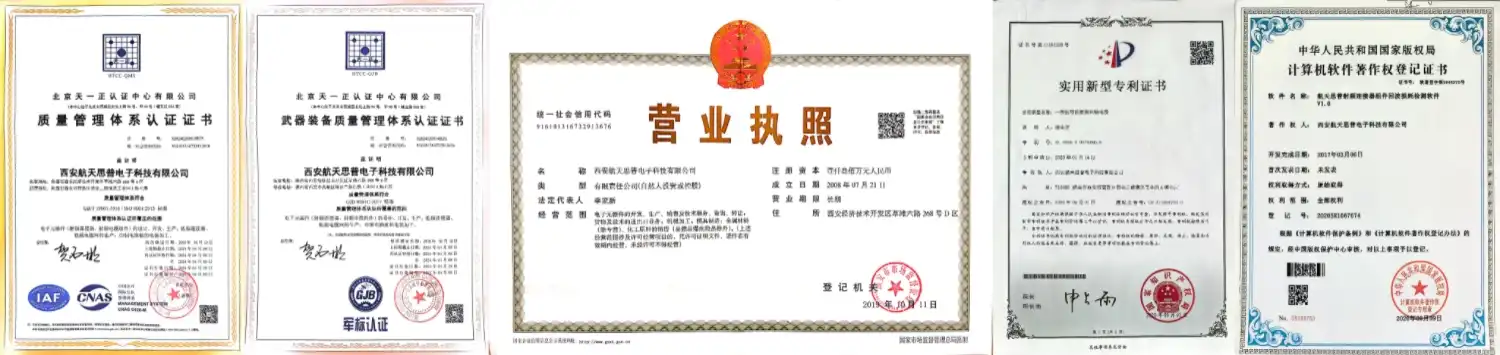
A good 2.92mm male to 2.4mm female gold-plated adapter maker should have experience with fine milling, plating, putting together, inspecting, and testing at high frequencies. Since its start in 1998 in Xi'an, China, SIPU RF Technology has been connecting RF and microwaves for more than 25 years. It has an ISO 9001-certified quality system and can do things like CNC machining, RF performance testing, fast development, and putting together connectors and cables. The company is in line with CE and RoHS rules, and its products meet MIL, GJB, and IEC standards. Certifications of materials show that the outer conductors made of brass and the contacts made of beryllium bronze meet the requirements.
Use This Procurement Checklist
Read these three reviews over before you send out an order.
- Technical review: Check the DC-40GHz range, the VSWR and insertion loss formulas, the 50 Ω impedance, the body and contact materials, plating, and mating-cycle rating of the 2.92mm male to 2.4mm female gold-plated adapter. First, use your own analyzer to measure a sample. This way, your metrology team can approve the part based on data from your setup.
- Quality review: Find out how the supplier checks each batch. SIPU checks each unit for dielectric withstanding voltage and insulation resistance, takes samples of the gold plating's thickness and adhesion by batch, and makes sure that every production batch meets RoHS requirements. Tell the team what test records they need for your upcoming inspection and ask them what they have.
- Commercial review: Check the samples, minimum order quantity (MOQ), price levels, customer service for warranties, packaging, and lead time. SIPU can make prototypes and large quantities. They ship standard RF connectors from stock and guaranty delivery within 72 hours, and they answer questions within 12 hours. Find out if the exact type you want is in stock and make sure the team can handle recurring sales.
Samples, Volume Orders, and Lead Time
First, look at a sample. Next, check the first piece. Finally, put the work in order by amount. SIPU can do both small-scale production and large-scale production. It also lets OEMs and ODMs change the frequency range, VSWR, insertion loss, materials, and mechanical design to fit special needs. People who buy from SIPU in the US and Canada work with its local partner, JNP Supplies LLC, in Seattle, WA, to coordinate projects and provide support in those areas. Before and after you place an order, you can get help choosing a product and technical support. If you're in the distribution business, a trial order lets you check the part with a real customer before you commit to buying more.
Conclusion
It comes down to how well the interface fits and the numbers being checked before buying a 2.92mm male to 2.4mm female gold-plated adapter. It's important to check the gender, thread, and interface standard first because the 2.4mm side doesn't fit with SMA. Then, check the part's DC-40GHz range, VSWR of ≤1.05 + 0.008F, insertion loss of ≤0.05√F dB, contact resistance, and whether it can be mated at least 500 times. From -65°C to +125°C, the gold plating, beryllium bronze contacts, PEI dielectric, and silicone rubber sealing keep the performance stable. For small links, a rigid adapter works best, while a wire assembly is best for ports that aren't lined up right. Compare the unit price to the uniformity of the batches, the inspection records, and the wait time. Then, use your own analyzer to check everything.
FAQ
1. Can a 2.92mm male to 2.4mm female gold-plated adapter mate with SMA?
It has a male side that is 2.92mm and a female side that is 3.5mm. When you want to connect to SMA, you need a different adapter configuration because the 2.4mm female side doesn't fit with SMA. Ask SIPU to help you choose the right one.
2. What frequency range should I expect?
The SIPU-2.92/2.4-JK works from DC to 40GHz at 50 Ω. That's the top speed of the 2.92mm interface, even though most 2.4mm devices can go up to 50 GHz. Use the VSWR and insertion loss methods at the highest frequency you can test, and then check with a sample on your own analyzer.
3. How many mating cycles can I plan for?
There must be at least 500 mating cycles. That number changes when you handle it, so keep the threads clean, use a measured torque wrench, don't drop the adapter, and keep it in a clean, dry place between -65°C and +125°C.
4. Does it fit high-density RF modules?
Yes. The straight shape and small size make it good for test benches and RF modules that are already full. The secure connection structure keeps the connection from being lost by accident in places where vibrations are common. When ports aren't lined up right, pair it with a cable assembly.
Request a Quote for a 2.92mm Male to 2.4mm Female Gold-Plated Adapter
Need an honest company to get 2.92mm male to 2.4mm female gold-plated adapter for your lab or OEM line? Send an email to info@sipu-rf.com with your frequency range, amount, and purpose, and our team will help you choose, get samples, and get your order delivered. SIPU offers both prototype and mass production, quality management under ISO 9001, and a response time of 12 hours for questions. For more information, go to sipuconn.com.
References
1. IEEE Standard for Precision Coaxial Connectors (DC to 110 GHz), IEEE Std 287, 2007
2. Radio-Frequency Connectors – Part 40: Sectional Specification for 2.4 mm Coaxial Connectors, IEC 61169-40, 2015
3. Microwave Engineering, 4th Edition, David M. Pozar, 2011
4. Fundamentals of Vector Network Analysis, Michael Hiebel, Rohde & Schwarz, 2011
5. Quality Management Systems – Requirements, ISO 9001, 2015
6. Directive 2011/65/EU on the Restriction of Hazardous Substances (RoHS), 2011
Contact us directly for customized solutions, quotations and long-term strategic cooperation.