- English
- French
- German
- Portuguese
- Spanish
- Russian
- Japanese
- Korean
- Arabic
- Greek
- German
- Turkish
- Italian
- Danish
- Romanian
- Indonesian
- Czech
- Afrikaans
- Swedish
- Polish
- Basque
- Catalan
- Esperanto
- Hindi
- Lao
- Albanian
- Amharic
- Armenian
- Azerbaijani
- Belarusian
- Bengali
- Bosnian
- Bulgarian
- Cebuano
- Chichewa
- Corsican
- Croatian
- Dutch
- Estonian
- Filipino
- Finnish
- Frisian
- Galician
- Georgian
- Gujarati
- Haitian
- Hausa
- Hawaiian
- Hebrew
- Hmong
- Hungarian
- Icelandic
- Igbo
- Javanese
- Kannada
- Kazakh
- Khmer
- Kurdish
- Kyrgyz
- Latin
- Latvian
- Lithuanian
- Luxembou..
- Macedonian
- Malagasy
- Malay
- Malayalam
- Maltese
- Maori
- Marathi
- Mongolian
- Burmese
- Nepali
- Norwegian
- Pashto
- Persian
- Punjabi
- Serbian
- Sesotho
- Sinhala
- Slovak
- Slovenian
- Somali
- Samoan
- Scots Gaelic
- Shona
- Sindhi
- Sundanese
- Swahili
- Tajik
- Tamil
- Telugu
- Thai
- Ukrainian
- Urdu
- Uzbek
- Vietnamese
- Welsh
- Xhosa
- Yiddish
- Yoruba
- Zulu
Choosing an SSMB Female Right Angle Connector for RG316 Cable: 5 Key Factors
Selecting the right SSMB female right angle connector for RG316 cable can make or break your RF system's performance. Whether you are designing a communications test fixture, a GPS module assembly, or an industrial RF instrument, this decision affects signal quality, mechanical reliability, and project timelines. In this guide, I walk through five key factors that every RF engineer and procurement professional should evaluate before committing to a connector—and show you exactly how SIPU's SIPU-SSMB-KW3-3 addresses each one.
Understanding the Technical Specifications of SSMB Female Right Angle Connectors for RG316 Cable
Make sure that the electrical specs of the connector match the design of your system before you buy anything. There is a chance that the readings will be wrong or the sample tests will fail, which will take weeks to fix.
Impedance and Frequency Range
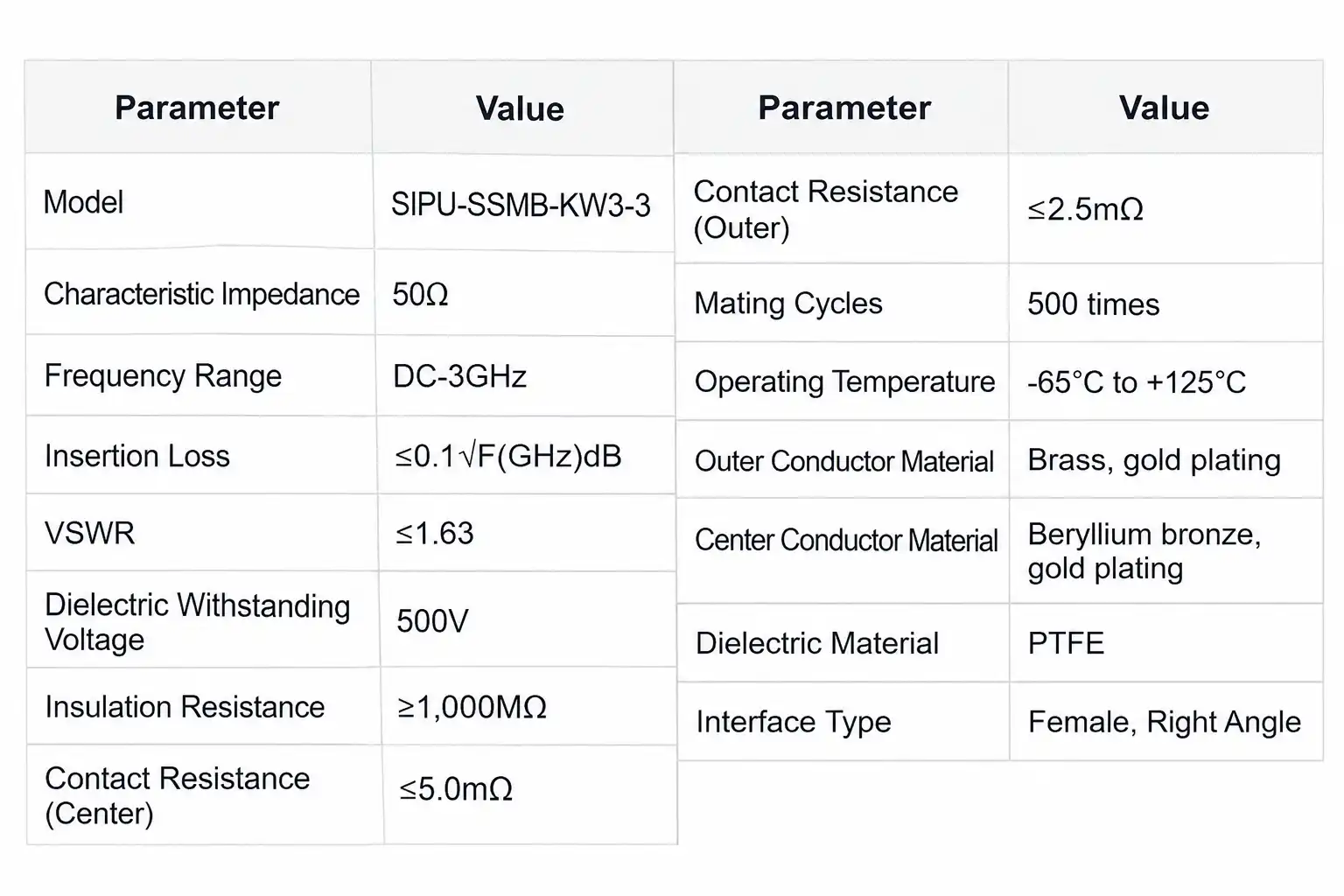
The SIPU-SSMB-KW3-3 keeps its 50 Ω characteristic impedance from DC to 3 GHz. This includes most of the bands that are used to test communications, GPS/BeiDou, and RF readings in industry. When making an RF design, the first thing that needs to be checked is that the impedance match stays the same across the whole range.
Insertion Loss and VSWR
A lot of the time, test setups go wrong when there is signal reflection. It can keep insertion loss at 0.1√F(GHz) dB and VSWR at -1.63. There is no need for engineers to worry about high VSWR because these numbers give them a clear, measured guarantee before even a single sample ships.
Material and Dielectric Selection
The outside is made of gold-plated brass, the middle contact is made of beryllium bronze, and the insulator is PTFE. Gold plating stops rusting, beryllium bronze keeps the spring's tension even after 500 times of mating, and PTFE keeps temps stable between -65 °C and +125 °C. These choices of materials directly help keep things stable from one batch to the next, which is important to everyone who works in production.
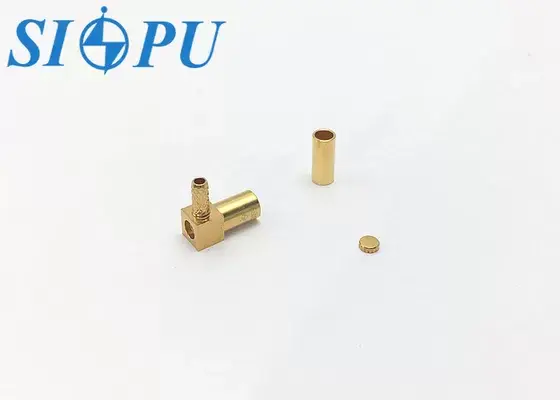
SSMB female right angle connector for RG316 cable take up less space than regular SMB or SMA connectors, but they still have a 50 Ω interface. This makes it a good choice for PCB plans with a lot of parts that need to fit in a small area.
Installation and Compatibility Considerations for RG316 Cable
Sometimes, a well-made connector won't work right if it's put together wrong or with a wire that wasn't made to work with it.
Mechanical Fit with RG316/U
RG316/U coaxial wire is what the SIPU-SSMB-KW3-3 is made to work with. Copper-clad steel that has been silver-plated is used to make the main conductor of RG316. FEP is used to make the jacket. This makes it very flexible and able to handle a wide range of temperatures. Both the crimp ferrule and the shape of the center contact on the connection are exactly the right size for this cable. This makes a smooth change in resistance, which lowers signal echoes at the end point.
Right-Angle Routing Advantages
A real space problem can be solved by setting things up at 90 degrees. It is very easy for the wire to bend very sharply when PCBs are stacked and casings are small. This makes the wire more likely to bend, which can weaken its electrical performance over time. With the right-angle exit, that stress is reduced, and the overall shape of the unit stays smaller. This is helpful for projects that need to cut feedlines shorter, as each millimeter counts.
Tooling and Installation Best Practices
You need a precise hex crimp tool for the outer ferrule and a fine-tip soldering station for the center wire. These work tools will be owned by everyone on an RF production team. The insulation resistance will stay above 1,000 MΩ and the dielectric withstanding voltage will reach 500 V if you follow the manufacturer's instructions for strip length and ferrule size. This is proven by SIPU's regular production inspections.
Performance and Benefits of Choosing High-Quality SSMB Female Right Angle Connectors
A connection that is stable doesn't make field returns; instead, its performance stays the same from batch to batch.
A production-grade micro-miniature RF connection is different from a standard part in the following ways:
- Low, stable VSWR: A VSWR ceiling of ≤1.63 through 3 GHz limits signal reflection to a level that keeps test and measurement results accurate. Even a small VSWR deviation can invalidate calibration data in a communications test system.
- Repeatable contact resistance: Center contact resistance ≤5.0 mΩ and outer contact resistance ≤2.5 mΩ keep resistive loss predictable across every unit in a production batch—directly addressing the batch inconsistency concern that disrupts OEM schedules.
- Thermal endurance: The −65 °C to +125 °C operating range covers indoor test labs, outdoor base-station enclosures, and avionics environments without requiring a connector change between application types.
Procurement and Sourcing Strategies for SSMB Female Right Angle Connectors
A reliable supply chain for SSMB female right angle connector for RG316 cable requires more than a competitive unit price.
Certification and Quality System Verification
Verify that the supplier holds ISO 9001 certification and that products comply with RoHS requirements. SIPU operates under ISO 9001 and subjects every production batch to RoHS environmental testing, plating thickness inspection, and dielectric withstanding voltage verification. CE compliance is also covered, which matters for any product entering U.S. or European markets.
OEM and Small-Batch Capability
Many RF projects start with small, multi-SKU sample orders before scaling. SIPU supports this workflow with stock availability for standard configurations, 72-hour delivery on standard items, and dedicated production lines for custom orders. This structure matches the inquiry→sample→mass production cycle that most OEM engineers follow, and it avoids the supply disruption risk that comes with single-source dependency.
Local Support and Responsiveness
SIPU partners with JNP Supplies LLC in Seattle, Washington, providing U.S.-based communication for North American buyers. Combined with a 12-hour inquiry response commitment and full technical documentation including datasheets and application guidance, this support structure shortens the qualification timeline significantly for procurement teams working on compressed schedules.
Making the Final Choice: Decision-Making Factors When Selecting an SSMB Female Right Angle Connector for RG316 Cable
Does the Connector Match Your Electrical and Mechanical Environment?
If the system says something is wrong with the frequency range, resistance, VSWR, or cables, make sure it is fixed. In the DC–3 GHz range, the SIPU-SSMB-KW3-3 meets all four needs without the need for any special building. It works with RG316/U wire and needs a right-angle exit.
Can the Supplier Demonstrate Batch Consistency?
As for production inspection records or a test report with VSWR, contact resistance, and plate adhesive for a sample lot, those should be asked for. SIPU's quality control method at the batch level looks at all of these things. For procurement engineers, this is written proof that their own background checks were done.
Are Certifications Sufficient for Your Regulatory Path?
In North America and Europe, ISO 9001, RoHS, and CE approval are usually enough to meet the needs of GPS modules, telecommunications, and industrial RF uses. Check that the certificates are up-to-date and that the supplier can give you extra copies if you ask.
You can choose a provider in a structured way if you match these three steps to the needs of your project. Instead of guesses, you can use data to back up your choice to your engineering boss and buying team.
Conclusion
Choosing the right SSMB female right angle connector for RG316 cable involves evaluating five interconnected factors: technical specifications, installation compatibility, performance consistency, sourcing reliability, and final selection criteria. The SIPU-SSMB-KW3-3 addresses each factor with documented specifications—50 Ω impedance, DC–3 GHz range, VSWR ≤1.63, gold-plated brass and beryllium bronze construction, and ISO 9001-certified production. For RF engineers managing short procurement cycles and multi-SKU prototype builds, this combination of specification clarity and supply chain support reduces project risk at every stage.
FAQ
1. What is the main functional difference between an SSMB and an SMB connector?
SSMB is a micro-miniature version of the SMB interface, with a smaller outer diameter. Both use a snap-on coupling mechanism, but SSMB occupies less board space, making it preferable in high-density assemblies where SMB's footprint is too large.
2. Can this connector be used with RG174 cable?
RG174 and RG316 have similar outer diameters, but RG316 uses a silver-plated copper-clad steel inner conductor and an FEP jacket that differ from RG174's construction. The SIPU-SSMB-KW3-3 is optimized for RG316/U; using RG174 may require a different ferrule specification for correct crimp retention.
3. Does the right-angle design affect insertion loss compared to a straight connector?
With proper impedance control, any additional insertion loss at the bend is minimal. This connector maintains ≤0.1√F(GHz) dB, which is within acceptable limits for most applications up to 3 GHz.
4. How should I verify batch consistency before a production order?
Request a batch inspection report covering VSWR, contact resistance, plating thickness, and dielectric withstanding voltage. SIPU provides this documentation as part of its standard quality assurance process.
5. What does the snap-on mating interface mean for maintenance access?
The snap-on interface allows quick connect and disconnect without tools, rated for 500 mating cycles. This makes it practical for test fixtures that require frequent connector changes during prototype evaluation.
Get Your SSMB Female Right Angle Connector for RG316 Cable from SIPU
Since more than 25 years ago, SIPU RF Technology has been making high-precision RF connections for people in the military, business, and telecommunications. To get a good SSMB female right angle connector for RG316 cable, SIPU has them in stock. They follow ISO 9001 rules when making their products and offer help in the U.S. through JNP Supplies LLC. Email info@sipu-rf.com right now with your needs or to ask for samples. You can also ask a question and look at full datasheets at sipuconn.com.
References
1. Pozar, D. M. Microwave Engineering, 4th ed. Wiley, 2011.
2. IEC 61169-4:2016. Radio-Frequency Connectors — Part 4: Sectional Specification for rf coaxial connectors with Inner Diameter of Outer Conductor 4.13 mm. International Electrotechnical Commission, 2016.
3. MIL-STD-348B. Interface Standard: Radio Frequency Connector Interfaces for MIL-PRF-39012 Connectors. U.S. Department of Defense, 2013.
4. Hiebel, M. Fundamentals of Vector Network Analysis. Rohde & Schwarz, 2007.
5. IPC/WHMA-A-620D. Requirements and Acceptance for Cable and Wire Harness Assemblies. IPC, 2022.
6. Laverghetta, T. S. Handbook of Microwave Testing. Artech House, 1981.
Contact us directly for customized solutions, quotations and long-term strategic cooperation.