- English
- French
- German
- Portuguese
- Spanish
- Russian
- Japanese
- Korean
- Arabic
- Greek
- German
- Turkish
- Italian
- Danish
- Romanian
- Indonesian
- Czech
- Afrikaans
- Swedish
- Polish
- Basque
- Catalan
- Esperanto
- Hindi
- Lao
- Albanian
- Amharic
- Armenian
- Azerbaijani
- Belarusian
- Bengali
- Bosnian
- Bulgarian
- Cebuano
- Chichewa
- Corsican
- Croatian
- Dutch
- Estonian
- Filipino
- Finnish
- Frisian
- Galician
- Georgian
- Gujarati
- Haitian
- Hausa
- Hawaiian
- Hebrew
- Hmong
- Hungarian
- Icelandic
- Igbo
- Javanese
- Kannada
- Kazakh
- Khmer
- Kurdish
- Kyrgyz
- Latin
- Latvian
- Lithuanian
- Luxembou..
- Macedonian
- Malagasy
- Malay
- Malayalam
- Maltese
- Maori
- Marathi
- Mongolian
- Burmese
- Nepali
- Norwegian
- Pashto
- Persian
- Punjabi
- Serbian
- Sesotho
- Sinhala
- Slovak
- Slovenian
- Somali
- Samoan
- Scots Gaelic
- Shona
- Sindhi
- Sundanese
- Swahili
- Tajik
- Tamil
- Telugu
- Thai
- Ukrainian
- Urdu
- Uzbek
- Vietnamese
- Welsh
- Xhosa
- Yiddish
- Yoruba
- Zulu
TNC Female to Female Adapter Flange: DC–11GHz Design Considerations
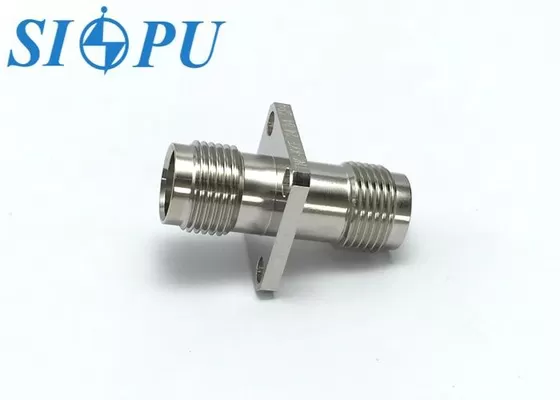
A TNC female to female adapter flange is a panel-mounted, 50 Ω coaxial joint that connects two TNC male cables or components through a panel or chassis wall. For DC–11GHz designs, thread compatibility is only the starting point. Connector geometry, the PTFE dielectric, contact quality, and mounting accuracy all shape VSWR and insertion loss. The short answer: verify tested VSWR and insertion loss across the full band, match the hole pattern to your cutout drawing, and ask for batch-level plating records. I wrote this guide so structural engineers, RF engineers, and buyers can check each point before a part reaches the assembly line.
Core Construction and Key Specifications of a TNC Female to Female Adapter Flange
How the Adapter Carries the RF Path
The connector fits with a TNC male plug on both sides of a panel because each end has a TNC female plug. The signal is sent by a gold-plated beryllium bronze center contact. It is held in place by a PTFE dielectric, and the outer shield is closed by a nickel-plated brass body. They work together to make a 50 Ω coaxial line that goes all the way through the wall. The mechanical load is on the flange. Since it's attached to the panel with bolts, when the cable or connector is pulled or torqued, it hits the housing instead of the circuitry. Following IEC 61169-17, the TNC interface has a threaded connection that works better when the cable is moving than a bayonet-style BNC. To sum up, a TNC female to female adapter flange is both a signal path and a support for wires.
Rated Electrical Values for the SIPU-TNC-KKF-1
This is the data sheet for our TNC female to female adapter flange, model SIPU-TNC-KKF-1. Here are the rated values:
| Parameter | Value |
|---|---|
| Impedance | 50 Ω |
| Frequency range | DC–11GHz |
| Insertion loss | ≤0.06√F(GHz) dB |
| VSWR | ≤1.3 |
| Dielectric withstanding voltage | 1,500 V |
| Insulation resistance | ≥5,000 MΩ |
| Center contact resistance | ≤2.0 mΩ |
| Outer contact resistance | ≤0.2 mΩ |
| Mating cycles | 500 |
| Operating temperature | -65℃ to +125℃ |
It's possible to lose up to 0.2 dB at 11 GHz, and a VSWR of 1.3 means a return loss of about 17.7 dB. You can plan for the RF link with those two numbers before the first sample comes in.
Nominal Range Versus Tested Range
This number tells you what frequency a certain type of connector can handle. A tested rating tells you that a certain part worked as well as it could for the whole band. Find out if the limits on VSWR and insertion loss are valid from DC to 11 GHz or only at spot frequencies. Find out what kind of fixtures and calibration the supplier used. The numbers can be different depending on how they were set up. How much power is handled also depends on the frequency, duty cycle, temperature outside, and heat inside the enclosure. A closed box that doesn't let much air flow gets hotter than a table that is open. Our specification says that the VSWR is 1.3 over the whole frequency range, so it's easy for you to compare prices. If your plan needs a power number, send us the duty cycle and frequency, and our engineers will make sure this is correct.
Dimensional and Mechanical Design Considerations for a TNC Female to Female Adapter Flange
Flange Dimensions and Hole Patterns
A structural engineer looks at the hole pattern to decide if two parts can be switched out. Check the body diameter, the number of holes, the distance between holes, the diameter of the holes, and any countersinks or counterbores. A small mistake in the spacing can mean that you have to re-punch a panel that passed inspection the first time. Because product pictures don't show limits, ask for the supplier's drawing and compare it to your cutout in 3D CAD. Check the overall size and centerline height of the part with parts that are close by. Find a fit problem on the drawing first, and it will only take minutes. Find the same problem on the sample, and it will take weeks. We will look over your standard chassis cutout plan with our experts before we make samples. Let us have it by email. If you need a different shape for your TNC female to female adapter flange, we can also do custom mechanical design.
Vibration, Torque, and Access
Vibration first loosens weak joints. There is less vibration with a threaded TNC coupling than with a bayonet connector. However, the flange screws still need to be the right size and be tightened according to the way shown on your drawing. There should be enough space at the connector for a torque tool and for the cable to bend without pulling on the wires. When you press a flange against a flat, rigid panel, the load on the cables is spread out evenly. But if the panel is warped, it can bend the body and change the alignment of the contacts. Mating is also important. The SIPU-TNC-KKF-1 can be mated 500 times, which makes it perfect for service panels that need to be reconnected a lot.
Panel Thickness and Installation Steps
Before you put in a TNC female to female adapter flange, make sure you know the frequency range, connection gender, 50 Ω impedance, and the state of the connecting plugs. Check the drawing to see how thick the panel is, and clean the mounting surface so the flange can sit flat on conductive metal. Electromagnetic shielding works because a grounded panel gives the shield a short return path. Protective caps should be left on until mating, and the center contact should be kept clean, straight, and free of extra force. Run a visual check, a continuity check, and either a VSWR or insertion-loss measurement after putting the parts together, depending on what your program says. Make a note of the results so that maintenance teams can find each port again later.
Materials, Plating, and Environmental Compatibility
Body, Contact, and Dielectric Choices
The whole stack of materials is more important than just the main body. The base of our adapter is made of nickel-plated brass, which protects it from rust and electromagnetic fields. It has a gold-plated beryllium brass middle conductor that keeps contact resistance low, and the PTFE dielectric keeps its electrical properties stable no matter the temperature. From -65℃ to +125℃, that combination can work. Brass is easy to work with and doesn't rust, so the cost per unit is low. It costs more, but stainless steel can handle rougher outdoor or marine use because it doesn't rust or wear down as quickly. Choose the body and plating based on the surroundings. For example, boxes inside, enclosures outside, cars, planes, and defense bunkers all need different options. Let us know if you need a different body material, and we'll look into it for your TNC female to female adapter flange.
Batch-Level Plating Inspection
A lot of OEM buyers are worried about batch consistency, and they have good reason to be. Plates that aren't even can make contact resistance higher, corrosion more likely, and two shipments act in different ways. Each batch of products made at SIPU is checked for thickness of the metal and strength of adhesive. That way, a team buying hundreds or thousands of pieces can get a check on each lot instead of just a sample from the first run. If your program needs information on corrosion, check to see if salt spray results are available for your setup. This is because ASTM B117 is the standard test method. Early on, let us know what you need for plating and the environment. These will affect both the sample plan and the batch inspection.
RoHS, ISO 9001, and Paperwork
Our TNC female to female adapter flange is tested for RoHS compliance on every batch that is made. This means that it can be shipped to markets that follow Directive 2011/65/EU. Our products are made using a quality management system that is ISO 9001 certified, and they also meet CE and RoHS standards. When inspecting arriving goods, make sure you have drawings, material declarations, inspection records, test data, and the ability to track each batch. For aerospace and defense projects, a full document chain is often needed for source approval. Let us know what kind of auditing you need at the price stage. If you need REACH or conflict-minerals declarations, you should ask for them in writing so the supplier can make sure they are available.
Comparing a TNC Female to Female Adapter Flange with Other Configurations
Flange, Inline, and Bulkhead Adapters
Two cables are joined by an inline female adapter, but it floats free, so the weight of the cables pulls on the joint. A nut-type bulkhead adapter fits through a single hole and clamps with a nut. This saves space on the panel but needs the torque of the nut to keep it from turning. A TNC female to female adapter flange is screwed to the panel. This spreads the load across several points and stops the plug from turning when it is tightened. In exchange, you have to drill more holes and leave a bigger footprint. For ports that get mated a lot, are vibrated, or have heavy wires, choose the lip. If you are setting up a bench, choose a straight bulkhead. If panel space is tight and loads are light, choose a nut-type bulkhead.
When a Custom Flange Makes Sense
Standard parts work when the book and your picture match. Need a custom hole pattern, a different direction, special sealing, private marking, or OEM packaging? Custom work will earn its fee. People often worry about slow sampling, so make sure you ask each supplier how long it takes to make custom orders. We have special production lines for custom orders, and we can make changes to the electrical, material, and mechanical parts, from making prototypes to mass production. Usually, it's easy: check the drawing, approve a sample, and then send out the batch. Make sure the test settings are the same for all quotes so that the frequency range, VSWR, and insertion loss limits line up.
Questions to Ask Any Supplier
Good questions can save weeks of work. Does the guaranty for DC–11GHz cover the whole band? Who set the limits for the VSWR and insertion loss tests, and how did they do it? Does it come with fixing hardware? What kinds of materials and plating do you need? Can you see inspection reports? How long does the lead time look like, and what are the sample terms? SIPU RF Technology has been making RF connectors since 1998 and is based in Xi'an. They offer CNC machining, assembly, RF testing, and rapid prototyping all under one roof. Getting an answer from us within 12 hours is helpful if your project has a tight deadline. Along with unit price, you should look at technology reaction and traceability.
Verification, Procurement, and Applications
Testing and Quality Control
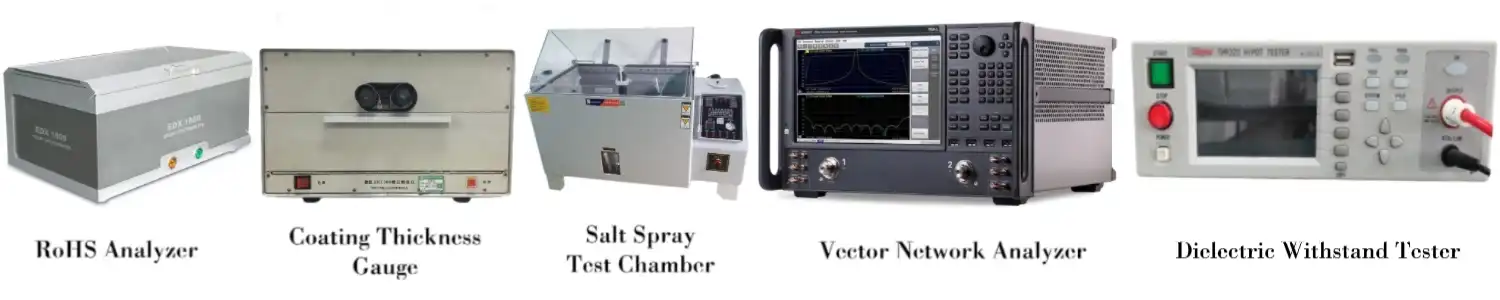
The standard way to measure VSWR, return loss, and insertion loss is with a vector network analyzer (VNA). Before you read the data, a test like SOLT (short, open, load, thru) gets rid of attachment error. You should add technical checks to any TNC female to female adapter flange to make sure the threads are in good shape and that the flange is the right size, with holes in the right place, is flat, and has good finishing. Our quality control checks that the dielectric can handle a voltage of 1,500 V, that the insulation resistance is greater than 5,000 MΩ, that the metal is thick enough and sticks well, and that each batch goes through RoHS testing. If your app needs data on changing temperatures, humidity, vibrations, or shocks, list those tests in the technical conditions right away.
Pricing, Availability, and Custom Orders
The price depends on the type of material, plating, machining complexity, RF testing, flange size, packaging, certification needs, and the number of orders. Standard RF connectors that are in stock can be delivered within 72 hours, so please ask us to confirm that your model is in stock. Custom flanges take longer because the plan needs to be looked over and a model needs to be made. Ask about tiered pricing, minimum order quantities, tooling costs, price guaranties, and safety stock choices to make sure that your yearly plan doesn't come as a surprise. We have a big cost benefit because we make and sell at the same time. We also help with the packing and shipping of goods for export. In North America, our partner JNP Supplies LLC in Seattle, Washington, helps people in the US and Canada talk to each other and work together on projects.
Where These Adapters Work
Aerospace and avionics teams use a TNC female to female adapter flange for communication and instrumentation interfaces in the cockpit. This is because the threaded coupling can handle vibration. When telecom makers put it on base stations and remote radio heads, they place it as a bulkhead interface. It is used on chassis ports in military field equipment that see a lot of cable changes. Calibration sets are built around its low insertion loss and steady VSWR in test and measurement labs. Many OEM enclosure and cabinet builders use it as a standard way to connect internal and external cables through the panel. For repair jobs, it's often more important to fit the current hole pattern, 50 Ω impedance, and DC–11GHz rating than to choose a new design.
Conclusion
Two 50 Ω TNC interfaces can be joined by a TNC female to female adapter flange that goes through a panel. The flange takes mechanical stress off of the internal circuitry. For use between DC and 11GHz, the most important things to check are the VSWR and insertion loss across the whole band, as well as the hole shapes and sizes that match the cutout drawing. Resistance to vibration, access to torque, and panel flatness are also factors that affect mechanical integration. The choice of material and inspection of each batch of plating determines how resistant it is to corrosion and how consistent it is across big orders. RoHS records and ISO 9001 documents help with tracking. When standard hole patterns don't work, custom flanges are a good option because they can be used over and over again and can handle vibration better than inline types. Unit price should not be more important than proven performance, clear documentation, and consistent quality.
FAQ
1. What does DC–11GHz mean for this adapter?
The SIPU-TNC-KKF-1 can handle direct current up to 11 GHz, has a VSWR of 1.3 or less across the whole range, and can't lose more than 0.06√F(GHz) dB.
2. How does a flange adapter differ from an inline adapter?
When you bolt a TNC female to female adapter flange to a panel, the wire load goes into the housing. When you connect two cables with an inline adapter, there is no panel support, so the cables have to hold the weight.
3. How many mating cycles does it handle?
The SIPU-TNC-KKF-1 can work from -65°C to +125°C and has a rating of 500 mating cycles, making it perfect for panels that need to be reconnected a lot.
4. Can SIPU customize the mounting pattern of a TNC female to female adapter flange?
Yes. We can help you set your own electrical, mechanical, and material goals. We'll look over the fit with you after we get your drawing.
5. Which documents should a bulk order include?
Ask for sketches, lists of materials, and inspection reports that show the thickness of the plating, how well it sticks, and RoHS testing. At the quote stage, let us know if you need any other audit documents.
Request a TNC Female to Female Adapter Flange Recommendation from SIPU
Send SIPU an email at info@sipu-rf.com with your cutout drawing, frequency range, VSWR target, plating needs, and quantity. Our engineers will then help you choose the best TNC female to female adapter flange for your panel. As a supplier of TNC female to female adapter flanges, we can make prototypes or large quantities. We respond to questions within 12 hours and take care of shipping to other countries. Customers in the US and Canada can get help from our partner JNP Supplies LLC in Seattle. For more information, go to sipuconn.com.
References
1. Microwave Engineering (David M. Pozar, Wiley), 4th Edition, 2011
2. IEC 61169-1: Radio-frequency connectors, Part 1: Generic specification, International Electrotechnical Commission, 2013
3. ASTM B117: Standard Practice for Operating Salt Spray (Fog) Apparatus, ASTM International, 2019
4. Directive 2011/65/EU on the Restriction of Hazardous Substances (RoHS 2), European Parliament and Council, 2011
5. ISO 9001: Quality Management Systems, Requirements, International Organization for Standardization, 2015
6. Applying Error Correction to Network Analyzer Measurements, Application Note 1287-3, Keysight Technologies, 2002
Contact us directly for customized solutions, quotations and long-term strategic cooperation.