- English
- French
- German
- Portuguese
- Spanish
- Russian
- Japanese
- Korean
- Arabic
- Greek
- German
- Turkish
- Italian
- Danish
- Romanian
- Indonesian
- Czech
- Afrikaans
- Swedish
- Polish
- Basque
- Catalan
- Esperanto
- Hindi
- Lao
- Albanian
- Amharic
- Armenian
- Azerbaijani
- Belarusian
- Bengali
- Bosnian
- Bulgarian
- Cebuano
- Chichewa
- Corsican
- Croatian
- Dutch
- Estonian
- Filipino
- Finnish
- Frisian
- Galician
- Georgian
- Gujarati
- Haitian
- Hausa
- Hawaiian
- Hebrew
- Hmong
- Hungarian
- Icelandic
- Igbo
- Javanese
- Kannada
- Kazakh
- Khmer
- Kurdish
- Kyrgyz
- Latin
- Latvian
- Lithuanian
- Luxembou..
- Macedonian
- Malagasy
- Malay
- Malayalam
- Maltese
- Maori
- Marathi
- Mongolian
- Burmese
- Nepali
- Norwegian
- Pashto
- Persian
- Punjabi
- Serbian
- Sesotho
- Sinhala
- Slovak
- Slovenian
- Somali
- Samoan
- Scots Gaelic
- Shona
- Sindhi
- Sundanese
- Swahili
- Tajik
- Tamil
- Telugu
- Thai
- Ukrainian
- Urdu
- Uzbek
- Vietnamese
- Welsh
- Xhosa
- Yiddish
- Yoruba
- Zulu
How to Choose the Right SMA Female Right Angle Connector for Your RF Design
Choosing the right SMA female right angle connector directly affects how well your RF system performs. How well the signal works, how long it lasts, and how reliable it is over time depend on the connector you choose. This is true whether you are making a 5G base station, a test instrument, or an aerospace assembly. This guide talks about technical details, how to buy the product, how to judge sellers, and how well the product fits the application. With this information, your engineering team can safely go from testing samples to making a lot of them.
Understanding SMA Female Right Angle Connectors: Basics and Specifications
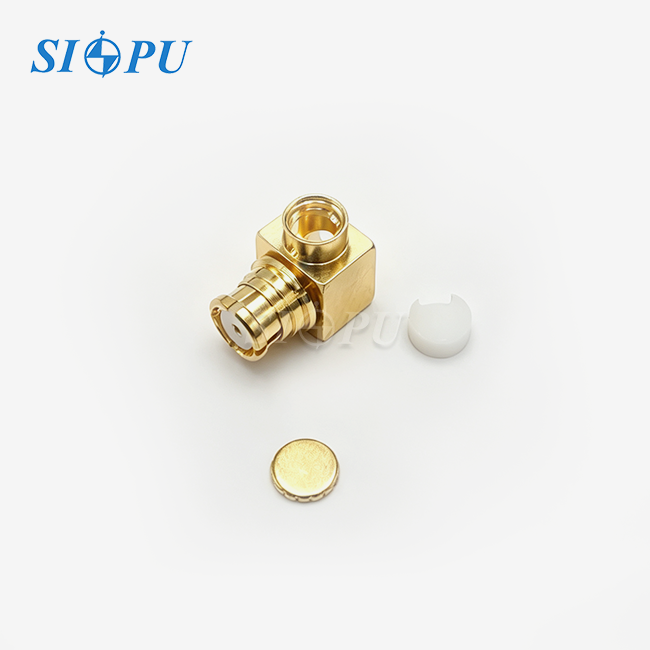
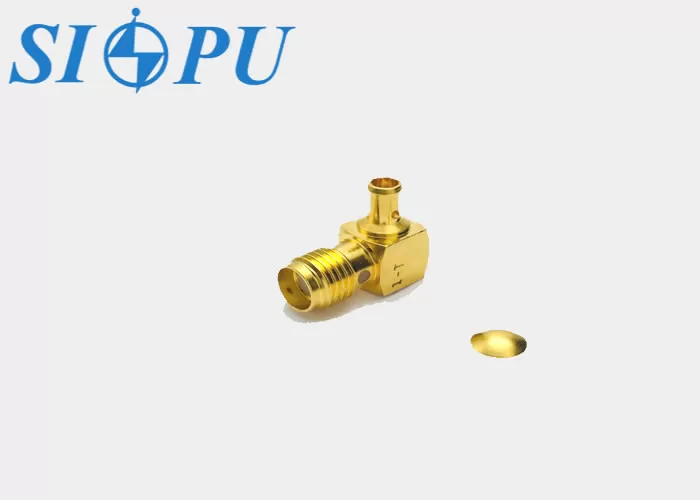
If you look at a SMA female right angle connector, it looks like an elbow at a 90-degree angle and has 50-ohm threads. It's possible to run cables through tight spaces without stretching them too far when you make that 90-degree turn. However, straight connectors can't do that on boards with a lot of components.
Core Electrical Properties
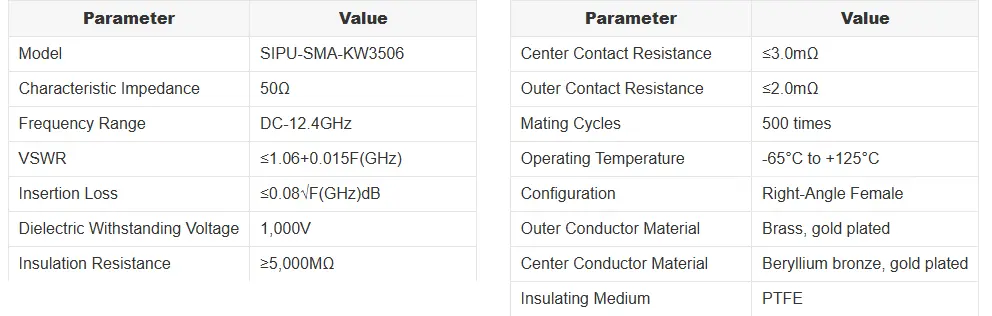
You can use a good SMA female right angle connector in almost all 4G/5G base stations, small cells, and BBUs on the market because it works from DC to 12.4 GHz. The SIPU-SMA-KW3506 has a VSWR of ≤ 1.06+0.015F(GHz) and an insertion loss of ≤ 0.08√F(GHz) dB across the whole band. When you put together AAU board RF chains or test phase-locked loop intermodulation, these numbers are very important.
Mechanical and Material Construction
The outer conductor is made of precisely machined brass with gold plating. The center contact is made of gold-plated beryllium bronze. This construction maintains high conductivity and corrosion resistance. The PTFE dielectric enables stable electrical performance across the operating temperature range of -65 °C to +125 °C. It can withstand voltages up to 1,000 V, and its insulation resistance is greater than 5,000 MΩ. In other words, it is suitable for commercial, telecom, and aerospace applications.
Standards and Compliance
IEC 61169-15 and MIL-STD-348 both say that the SMA link's characteristic resistance must be 50 ohms. The SIPU-SMA-KW3506 can usually be exported under EAR99 classification without any extra licenses as long as it meets the rules of RoHS, REACH, IEC, CE, and UL.
Comparing SMA Female Right Angle Connectors with Other Connector Types
Not every RF design calls for the same connector family. Understanding where the right-angle SMA interface wins—and where it does not—saves time during design reviews.
SMA vs. N-Type and TNC
N-Type and tnc connectors can handle more power and keep out water better in outdoor setups, but their bigger bodies make them useless on small RF boards. The SMA female right angle connector trades bulk for precision, making it the preferred choice for board-level signal routing inside chassis where depth and width are constrained.
SMA vs. RP-SMA
In consumer Wi-Fi products, RP-SMA connectors reverse the gender of the center contact to comply with regulatory requirements. An RP-SMA male connector uses a socket center contact, while an RP-SMA female connector uses a pin center contact. Because RP-SMA and standard SMA connectors look similar, they will not mate properly if mixed. Before you buy samples, check your bill of materials (BOM) to confirm the required gender standard.
SMA vs. SMP and MMCX
SMP and Mmcx connectors fit smaller PCB footprints and support push-on mating, which speeds up assembly. However, they are not as widely stocked, and their frequency ceiling is closer to 40 GHz in specialty versions. For DC-12.4 GHz applications with a need for threaded, vibration-resistant coupling, the SMA female right angle connector remains the most cost-effective and universally supported option.
Key Criteria for Choosing the Right SMA Female Right Angle Connector
If you choose the wrong connection for the sample, the job could be put off for weeks. Here is a structured way to look at your choices before choosing a supplier.
Define Your Electrical Requirements First
Find out your frequency range, your impedance, and how much VSWR you can handle first. A VSWR of 1.35:1 is often the maximum acceptable limit for a link, so make sure that the connector datasheet stays at or below that figure with some margin. It's also important that the touch resistance is low. Your signal chain will stay clean if the center contact resistance is less than 3 mΩ and the outer contact resistance is less than 2 mΩ.
Evaluate Physical and Mechanical Fit
Before you order, make sure you read the cable compatibility information. The SIPU-SMA-KW3506 is made to work with CXN3506 wire. If you use a cable that isn't the right match, it will add impedance discontinuities that can be seen right away on a VNA sweep. Also, make sure that the body of the connection doesn't touch any other parts on the board. The 90-degree shape makes the connector shorter but wider.
Confirm Procurement and Quality Parameters
Here are the procurement checkpoints that experienced RF engineers verify before approving a supplier:
- Certification documentation: Request RoHS test reports, IEC compliance declarations, and ISO 9001 certificates. These protect your product from regulatory issues in the US and EU markets.
- Sample lead time: For short-cycle projects with a 1–3 month decision window, confirm that prototype samples ship within a few business days, not weeks.
- Batch consistency: Ask for plating thickness data and dimensional tolerances across multiple production lots. VSWR drift between batches is a common failure mode in volume production.
- MOQ and pricing structure: Mixed-sample pricing at the engineering stage followed by negotiated volume pricing at production scale is a practical model for OEM projects with variable SKU counts.
These four checkpoints together give you a clear picture of whether a supplier can support both your prototype phase and your ramp-up to production without specification drift.
Leading Suppliers of SMA Female Right Angle Connectors
Several manufacturers supply SMA female right angle connectors to the global RF market. Amphenol and TE Connectivity offer broad catalog coverage with strong North American distribution. Times Microwave focuses on cable assembly integration. Each has strengths, but lead times, customization depth, and pricing flexibility vary considerably.
Why SIPU Stands Out for OEM Engineers
SIPU RF Technology was established in 1998 and is based in Xi'an, China. Each link that the company ships comes with over 25 years of manufacturing knowledge. The company runs dedicated military-grade production lines alongside commercial lines, which means the same process discipline that meets GJB standards applies to every commercial SMA female right angle connector order. CNC machining with tight dimensional tolerances, 100% plating inspection, and full electrical verification are standard, not optional add-ons.
Local Support in North America
SIPU works with JNP Supplies LLC in Seattle, Washington, to offer US-based customer service, faster project planning, and quick contact for buying teams in North America. When you are working on a project quickly and need answers, having a local presence is important.
Customization and Delivery Capability
Standard connectors are in stock and can be delivered in 72 hours. Different cable terminations, changed mechanical interfaces, or specific plating specs are all examples of custom configurations that are made on dedicated production lines with priority logistics. SIPU can do both OEM and ODM work, and they can set VSWR goals, choose materials, and make changes to mechanical designs.
How to Procure SMA Female Right Angle Connectors Efficiently
To get things quickly and cheaply, you need to figure out the best way to get them and keep an eye on risks all along the supply chain.
When you work directly with makers, you can get the most accurate price information and keep the most an eye on quality. You can get things done faster and sometimes find extra stock with authorized wholesalers, but it's harder to get straight information about production lots. When engineering teams move from making prototypes to mass production, they can work directly with a manufacturer like SIPU to get help with samples, get advice from engineers, and make more at the same time.
This is where you can talk about prices for mixed samples during the engineering process. In this way, you can try out different sets of cables and connectors without having to buy a whole production unit. Talk about volume terms and agreed-upon delivery windows once you're sure about the design. This will help you stick to your production schedule.
Conclusion
When looking for a SMA female right angle connector, you should make sure that it meets your project's electrical needs, meets the supplier's requirements, and has the right mechanical shape. Set goals for VSWR and frequency first, make sure the cables work, and check the quality of each batch before making a lot of them. SIPU has been making things for more than 25 years and has help in North America through JNP Supplies LLC. This makes it a useful SMA female right angle connector maker for OEM teams with projects that need to be finished quickly.
FAQ
1. Does the 90-degree bend affect signal performance?
The impedance change at the elbow stays within a very small range thanks to precise machining. The SIPU-SMA-KW3506 has a VSWR of less than 1.06+0.015F(GHz) across the whole DC-12.4 GHz range. This means that there is almost no signal reflection at the bend in normal test and telecom applications.
2. How do I verify the frequency specification before ordering?
Ask for the datasheet and VNA sweep data from a recent batch of products that were made. Look over the VSWR and insertion loss graphs for the frequency you want to use. For important designs, ask for a sample and use an accurate network tester to do your own testing.
3. Can these connectors handle vibration in aerospace or industrial settings?
Yes. The threaded coupling device firmly locks the fitting interface, and the beryllium bronze center contact keeps the contact force even when the interface moves. The 500-mating-cycle rating shows that the design was made to connect and disconnect many times in test or field settings.
4. What is the difference between SMA male and SMA female right angle connectors?
The SMA female right angle connector has a socket (receptacle) center contact and internal threads. The SMA male has a pin center contact and external threads. Match the gender to your mating connector, not to the device body—this is a common source of ordering errors.
5. How do I confirm RoHS and REACH compliance for my procurement records?
Ask your supplier for current batch test reports issued by an accredited third-party laboratory. SIPU provides RoHS documentation with each production order, supporting your compliance filing for US and EU markets.
Partner with SIPU for Your Next RF Connector Project
SIPU RF Technology makes SMA female right angle connectors that are very well designed and stay the same from batch to batch. SIPU can help you with your project from the first prototype to the finished product. They have things in stock, deliver normally in 72 hours, and can make changes to fit the needs of OEMs. To get a sample of the SIPU-SMA-KW3506 or to talk about your needs for a custom SMA female right angle connector supplier, please email us at info@sipu-rf.com or visit sipuconn.com.
References
-
IEEE Transactions on Microwave Theory and Techniques — 2021
-
IEC 61169-15: RF Connectors — Part 15: Sectional Specification for SMA Connectors — IEC, 2020
-
MIL-STD-348B: Radio Frequency Connector Interfaces for MIL-PRF-39012 — US Department of Defense, 2018
-
Microwave Journal: State of the Microwave Industry Report — 2023
-
RF Design Guide: Connector Selection for High-Frequency Applications — Microwave Product Digest, 2022
-
ISO 9001:2015 Quality Management Systems — Requirements — International Organization for Standardization, 2015
Contact us directly for customized solutions, quotations and long-term strategic cooperation.