- English
- French
- German
- Portuguese
- Spanish
- Russian
- Japanese
- Korean
- Arabic
- Greek
- German
- Turkish
- Italian
- Danish
- Romanian
- Indonesian
- Czech
- Afrikaans
- Swedish
- Polish
- Basque
- Catalan
- Esperanto
- Hindi
- Lao
- Albanian
- Amharic
- Armenian
- Azerbaijani
- Belarusian
- Bengali
- Bosnian
- Bulgarian
- Cebuano
- Chichewa
- Corsican
- Croatian
- Dutch
- Estonian
- Filipino
- Finnish
- Frisian
- Galician
- Georgian
- Gujarati
- Haitian
- Hausa
- Hawaiian
- Hebrew
- Hmong
- Hungarian
- Icelandic
- Igbo
- Javanese
- Kannada
- Kazakh
- Khmer
- Kurdish
- Kyrgyz
- Latin
- Latvian
- Lithuanian
- Luxembou..
- Macedonian
- Malagasy
- Malay
- Malayalam
- Maltese
- Maori
- Marathi
- Mongolian
- Burmese
- Nepali
- Norwegian
- Pashto
- Persian
- Punjabi
- Serbian
- Sesotho
- Sinhala
- Slovak
- Slovenian
- Somali
- Samoan
- Scots Gaelic
- Shona
- Sindhi
- Sundanese
- Swahili
- Tajik
- Tamil
- Telugu
- Thai
- Ukrainian
- Urdu
- Uzbek
- Vietnamese
- Welsh
- Xhosa
- Yiddish
- Yoruba
- Zulu
When Does an SMA Female to N Male Adapter Fit Best?
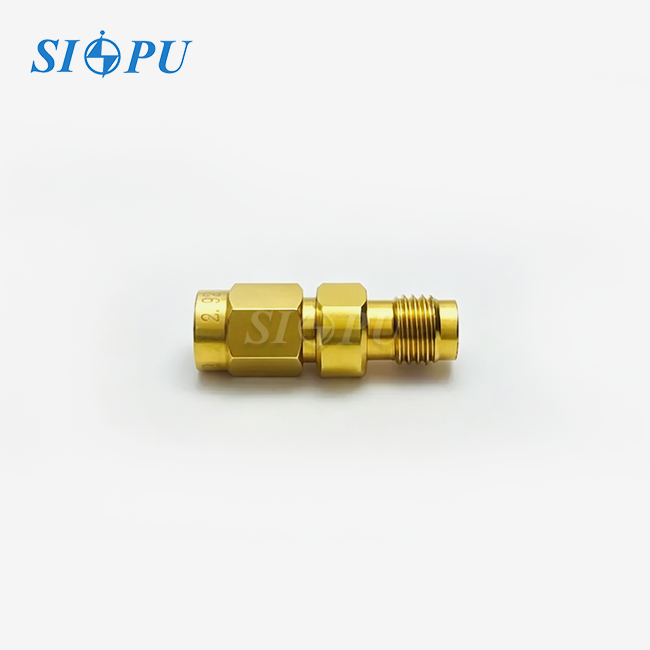
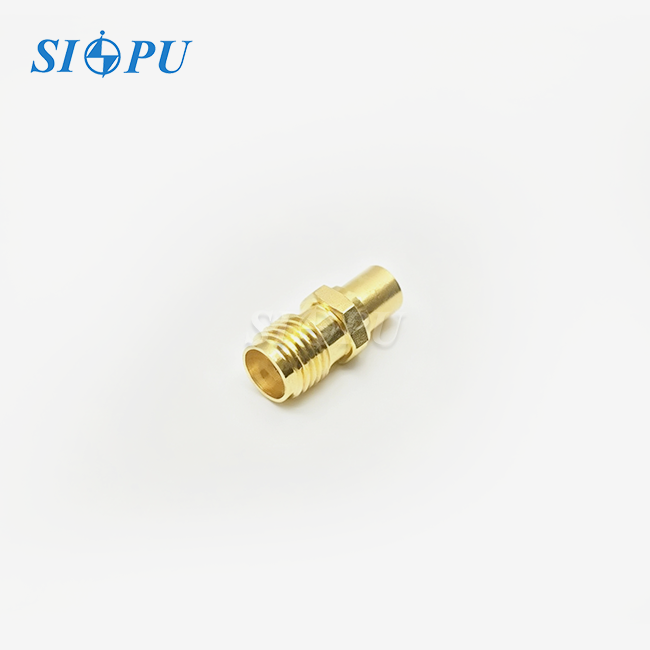
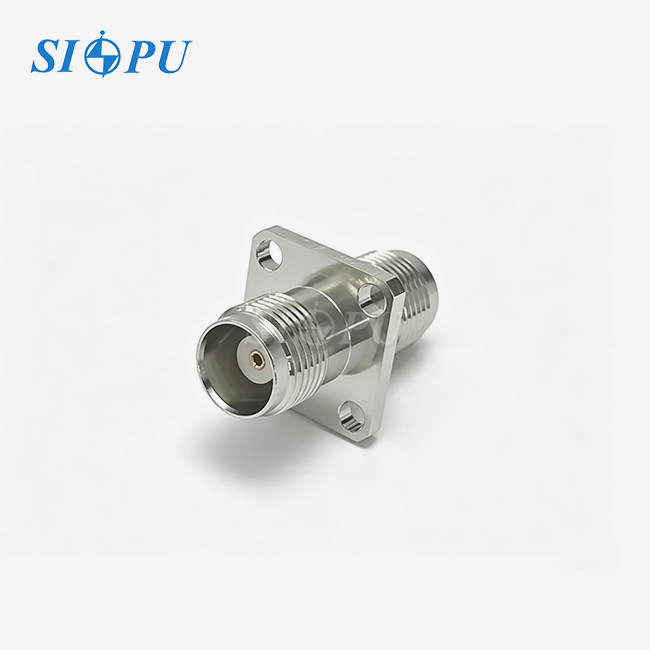
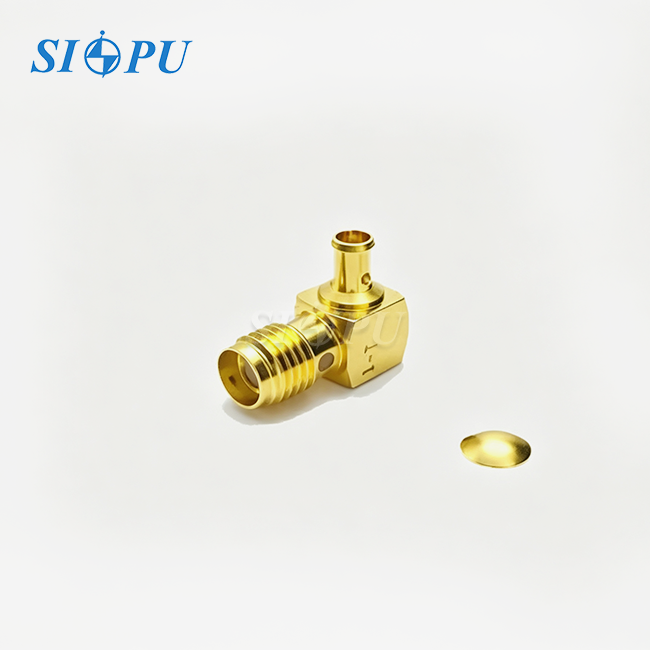
An SMA female to N male adapter fits best when your RF system requires a reliable, low-loss transition between compact SMA-equipped instruments and larger N-type infrastructure. In test labs, this adapter connects Vector Network Analyzers or spectrum analyzers to N-type cables with minimal signal degradation. Operating from DC to 11 GHz with VSWR ≤1.3 and insertion loss of ≤0.06√F(GHz)dB, the SMA female to N male adapter maintains 50Ω impedance continuity. It suits telecom installations, base station upgrades, and field deployments where connector mismatch would otherwise disrupt measurement accuracy or signal integrity.
Understanding the SMA Female to N Male Adapter and Its Specifications
Before you choose an RF connector, it's helpful to know what makes one type of adapter different from another. This will save you time and keep you from making mistakes that cost a lot of money. A ruggedized N-type series connector and a small SubMiniature version A (SMA) series connector can be joined together with the SMA female to N male adapter. There are different sizes and types for each one.
Structural Differences Between SMA and N-Type Connectors
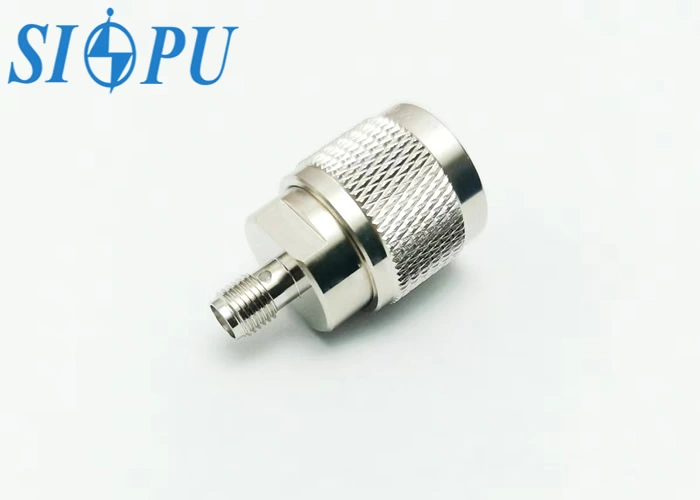
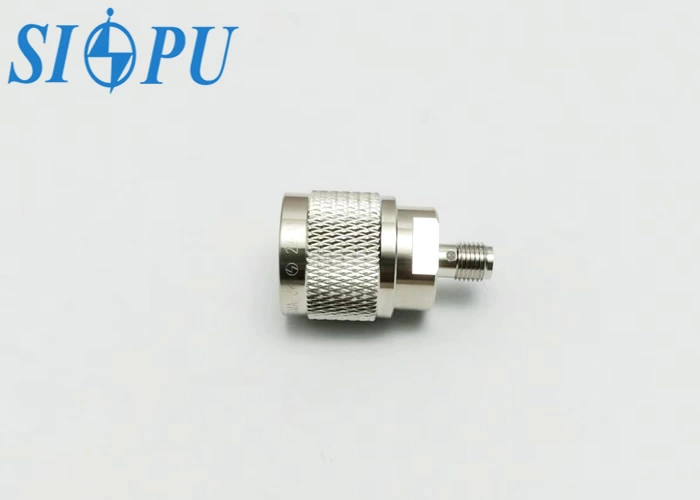
On the N male side, there are threads on the outside and a center pin that sticks out. The SMA side has threads on the inside and a hole in the middle that is hidden. The SMA female to N male adapter lets lab-grade SMA ports connect to heavier N-type cables without having to re-terminate the assemblies that are already in place.
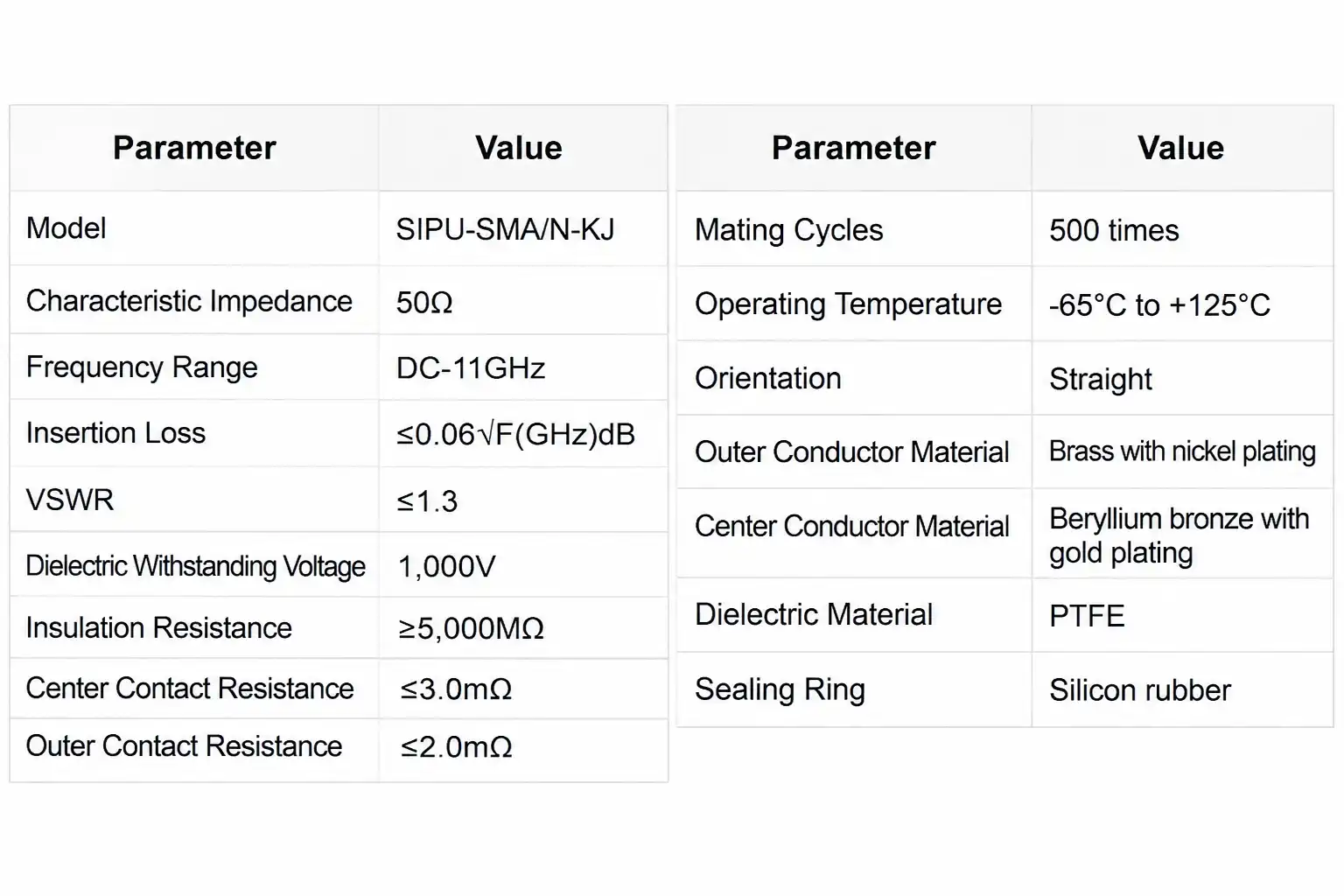
Key Electrical Specifications of SIPU-SMA/N-KJ
The SIPU-SMA/N-KJ model has a 50Ω characteristic impedance and works from DC to 11 GHz. The VSWR stays at 1.3, the dielectric can handle up to 1,000V, and the insulation resistance goes over 5,000MΩ. The insertion loss stays at -0.06√F(GHz)dB. There is a ≦3.0mΩ resistance in the center contact and a ≦2.0mΩ resistance in the outer contact. These are important numbers for places where precise readings are taken.
Material Choices That Drive Long-Term Performance
The top line is made of brass that has been nickel-plated to protect it from rust and electromagnetic fields. Bronze copper and gold have been put on top of each other to make the middle wire. The contact resistance will not change no matter how many times you connect it. Electricity stays the same inside thanks to a PTFE dielectric between -65°C and +125°C, and a silicon rubber close ring keeps the outside world out when the field is rough.
When to Choose an SMA Female to N Male Adapter — A Problem-Solving Approach
There is more than one way to fix a mismatched connector. If you know when a SMA-to-N transition adapter will work with your setup, you can avoid both over-engineering and under-performance. The following situations show common times when this type of adapter fixes real connectivity issues.
Mismatched Ports on Test Benches
When a power amplifier outputs through an N-type cable but your spectrum analyzer or VNA only accepts SMA connections, a direct mate is impossible. The SMA female to N male adapter resolves this instantly, eliminating the need for a replacement cable assembly and preserving the measurement chain's electrical integrity.
Outdoor Antenna and Base Station Integration
As 5G base stations get updated, older N-type feedlines are often paired with newer SMA-based radio modules. In these setups, an inter-series adapter made of materials that don't rust and can handle a wide range of temperatures works reliably even when the weather changes with the seasons. The SIPU-SMA/N-KJ's nickel-plated brass body can handle humidity outside without damaging the contact surfaces.
Phase-Locked Loop and Intermodulation Test Setups
RF test engineers running phase-locked loop (PLL) intermodulation tests need signal path components that introduce no measurable impedance discontinuity. A VSWR below 1.3 at frequencies up to 11 GHz means the SMA female to N male adapter adds negligible reflection, preserving measurement confidence during multi-instrument test sequences.
Comparing the SMA Female to N Male Adapter with Other Adapter Types
You need to know what each adapter position does physically in order to choose the right one. That way, you'll lose money on things you don't need and make projects run late.
SMA Female to N Male vs. SMA Male to N Female
The SMA female to N male adapter plugs into a N female port or cable and accepts a SMA male plug from the device. You can plug an N-type plug into the other end (SMA male to N female), and it will give you a SMA female port. Not because of how well they are thought to work, but because of the ports and wires they already have.
SMA Female to N Male vs. SMA Female to N Female
This is not often that you see a SMA female to N female connection in a barrel-style feed-through screen. It doesn't work with N male cable ends. With the SMA female to N male adapter, you can do most tasks at the bench or in the field that use N-type cables with male connectors.
Gold-Plated vs. Standard-Plated Center Contacts
Instead of silver or basic tin-plated center contacts, the SIPU-SMA/N-KJ uses gold-plated beryllium bronze ones. This makes the contact resistance stay lower even after many mating cycles. Adding gold directly slows down long-term signal loss growth in test environments where adapters are connected and disconnected a lot—sometimes hundreds of times a year. This means that adapters last longer and don't need to be replaced as often.
Procurement Insights: How to Source an SMA Female to N Male Adapter Efficiently
A lot of the time, procurement teams have to choose between speed, cost, and trust in the specifications. Before you place an order, you should think about these things.
Evaluating Supplier Specifications Against Your Application
Any reputable SMA female to N male adapter supplier should provide verified data on VSWR, insertion loss, mating cycle ratings, and operating temperature. Vague datasheets often indicate inconsistent manufacturing tolerances. Request batch test reports or certificates when ordering for test laboratory or production line use, where specification drift creates downstream failures.
Batch Consistency and Supply Continuity
When test labs buy adapters for more than one job, they need to know that they will work the same way on every delivery. Differences in plating thickness between batches, even if they are within specs, can change contact resistance enough to mess up sensitive readings. This risk is greatly reduced if you choose a manufacturer with documented batch-level inspection processes.
Pricing Structures for Small Batch and Multi-SKU Orders
RF test environments typically require small quantities across many connector types simultaneously. An SMA to N adapter supplier offering mixed-SKU sample pricing and short-cycle delivery windows (1–3 months) aligns better with project-based procurement patterns than suppliers with high minimum order quantities locked to single SKUs.
Installation and Compatibility: How to Connect an SMA Female to N Male Adapter Correctly
Even a well-specified adapter performs poorly when installed incorrectly. These practical steps protect both the adapter and the equipment it connects.
Torque and Hand-Tightening Guidelines
SMA connectors should be tightened to approximately 3–5 in-lb using a calibrated torque wrench. Over-tightening damages the internal thread or deforms the center pin. N-type connectors tolerate slightly higher torque — typically 12–15 in-lb — due to their larger thread pitch. Using the correct tool for each side of the SMA female to N male adapter prevents mechanical damage that shortens connector life.
Impedance and Frequency Compatibility Checks
Before finalizing a connection, confirm that all components in the signal chain are rated for 50Ω and that the cable assembly's frequency rating matches or exceeds the adapter's DC-to-11GHz range. Mixing 75Ω video-grade N-type cables with 50Ω adapters creates measurable reflection loss that appears as unexplained signal loss in measurement data.
Troubleshooting Intermittent Signal Loss
If measurements after installing the adapter show noise floors or VSWR spikes that can't be explained, check the center pin of the N male side for mechanical deformation. The most common way for field-used adapters to fail is for the center pin to become bent or depressed. Usually, replacing a single broken adapter fixes the problem right away, without having to reassemble the cables.
Conclusion
So, the SMA female to N male adapter fixes a certain mechanical issue without slowing down the signal. It's used in RF test labs, telecom installations, and OEM production lines. This kind of adapter works well and doesn't cost too much for uses that don't go above 11 GHz, need stable 50Ω resistance, and switch connections a lot. The quality of the materials, especially the gold-plated contacts and PTFE dielectric, has a bigger impact on how reliable something is over time. Choose a seller whose batch consistency has been checked and whose processes are quick to reply. This can lower project risk from the time of purchase to the time of rollout.
FAQ
1. What is the difference between an SMA female and an N male connector?
An SMA female connector has internal threads and a center socket. An N male connector has external threads and a center pin. These two connector families differ in size, power handling, and typical application. The SMA female to N male adapter physically bridges them into a single, secure interface.
2. Can this adapter support 5G test applications?
Yes, up to the sub-6GHz bands commonly used in 5G NR testing. The DC-to-11GHz range of the SIPU-SMA/N-KJ covers all current sub-6GHz 5G frequency allocations. For mmWave 5G applications above 11 GHz, a different adapter series would be required.
3. How do I know if an adapter is suitable for outdoor installation?
Check that the outer circuit is made of a material that won't rust, that the insulator is sealed, and that the working temperature range covers the extremes of your climate. The SIPU-SMA/N-KJ can be used in outdoor enclosures and field-deployed antenna systems because it has a nickel-plated brass body and a silicon rubber sealing ring.
4. Does connector plating affect measurement accuracy?
Yes. Gold-plated center contacts maintain more stable resistance across repeated matings compared to other plating types, which matters in precision measurements where contact resistance is part of calibration assumptions.
Get an SMA Female to N Male Adapter from a Verified Manufacturer — SIPU RF Technology
SIPU RF Technology has been making very accurate RF links since 1998. They've been in business for more than 25 years and are ISO 9001 certified. There are size rules around the world, RoHS, CE, and the SIPU-SMA/N-KJ SMA female to N male adapter meets all of them. Within 72 hours, standard stock ships, and trial orders with more than one SKU are taken care of first. To get a brochure, sample, or bulk price, email SIPU at info@sipu-rf.com or visit sipuconn.com.
References
1. Pozar, D. M. Microwave Engineering, 4th ed. John Wiley & Sons, 2011.
2. IEC 61169-15: Radio-Frequency Connectors — Part 15: Sectional Specification for rf coaxial connectors of Type N. International Electrotechnical Commission, 2013.
3. IEC 61169-16: Radio-Frequency Connectors — Part 16: Sectional Specification for RF Coaxial Connectors of Type SMA. International Electrotechnical Commission, 2013.
4. MIL-PRF-39012: Connectors, Coaxial, Radio Frequency, General Specification for. U.S. Department of Defense, 2019.
5. Amphenol RF. RF Coaxial Connector Application Guide. Amphenol Corporation, 2020.
6. Huber+Suhner. RF Interconnect Technology: Coaxial Adapters and Connectors Technical Reference. Huber+Suhner AG, 2021.
Contact us directly for customized solutions, quotations and long-term strategic cooperation.