- English
- French
- German
- Portuguese
- Spanish
- Russian
- Japanese
- Korean
- Arabic
- Greek
- German
- Turkish
- Italian
- Danish
- Romanian
- Indonesian
- Czech
- Afrikaans
- Swedish
- Polish
- Basque
- Catalan
- Esperanto
- Hindi
- Lao
- Albanian
- Amharic
- Armenian
- Azerbaijani
- Belarusian
- Bengali
- Bosnian
- Bulgarian
- Cebuano
- Chichewa
- Corsican
- Croatian
- Dutch
- Estonian
- Filipino
- Finnish
- Frisian
- Galician
- Georgian
- Gujarati
- Haitian
- Hausa
- Hawaiian
- Hebrew
- Hmong
- Hungarian
- Icelandic
- Igbo
- Javanese
- Kannada
- Kazakh
- Khmer
- Kurdish
- Kyrgyz
- Latin
- Latvian
- Lithuanian
- Luxembou..
- Macedonian
- Malagasy
- Malay
- Malayalam
- Maltese
- Maori
- Marathi
- Mongolian
- Burmese
- Nepali
- Norwegian
- Pashto
- Persian
- Punjabi
- Serbian
- Sesotho
- Sinhala
- Slovak
- Slovenian
- Somali
- Samoan
- Scots Gaelic
- Shona
- Sindhi
- Sundanese
- Swahili
- Tajik
- Tamil
- Telugu
- Thai
- Ukrainian
- Urdu
- Uzbek
- Vietnamese
- Welsh
- Xhosa
- Yiddish
- Yoruba
- Zulu
SMA Female to MCX Female Adapter: Features and Applications
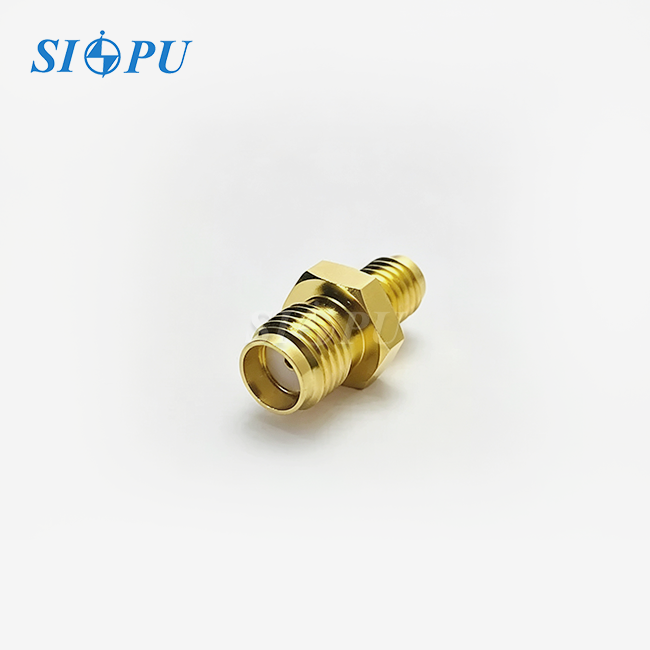
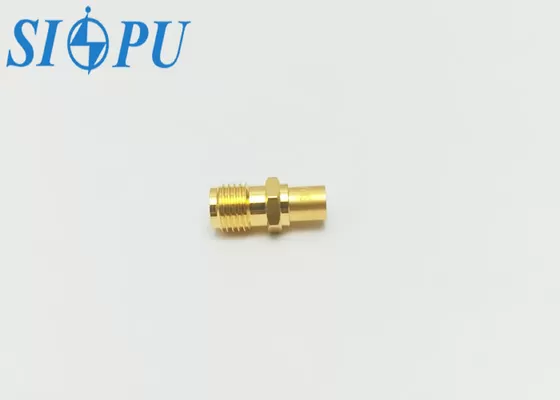
An SMA female to MCX female adapter joins an SMA male connector to an MCX male connector, so an instrument with a threaded SMA port can reach a compact device with a snap-on MCX port. It is a passive part, so it adds no gain and changes nothing in the signal. Its value comes from low loss, a clean 50 Ω match, and the same readings from one unit to the next. In this guide, I cover the features, specifications, and applications of the SIPU-SMA/MCX-KK from SIPU RF Technology. I also explain how to choose, verify, and source it.
What Is an SMA Female to MCX Female Adapter?
A Passive Transition Between Two Connector Families
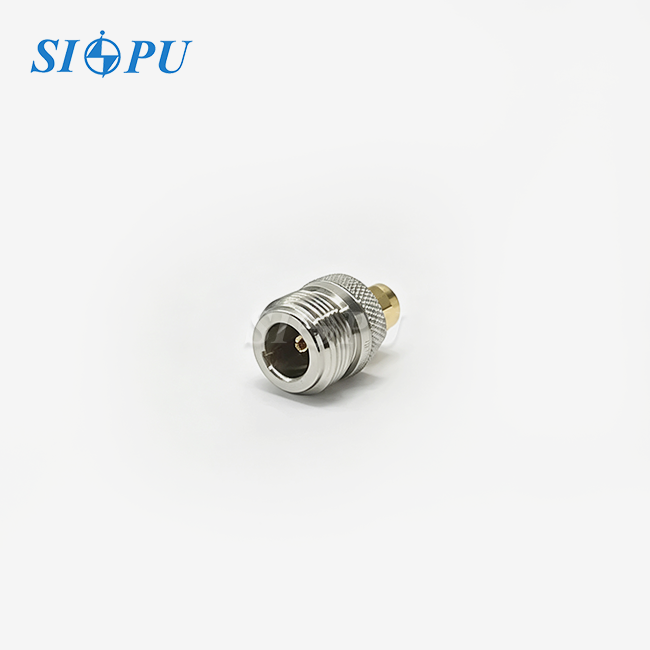
An SMA female to MCX female adapter is a passive RF part with a female jack on each end. There is an SMA male plug on one end and an MCX male plug on the other. The part does not boost, filter, or change anything because the signal goes straight through the center conductor and the outer shield. How well it works relies on the shape of the connector, the materials used, the limits for machining, and the frequency of operation. So, two adapters with the same name might not fit together the same way. When the results are going into a test report, I treat this part of the signal path as a measured part and not just a fitting.
How the SMA and MCX Interfaces Mate
The two interfaces are different in size and coupling. The SMA interface is described in IEC 61169-15. It uses a 1/4-36 threaded connection to make a tight link that can be used over and over again. The MCX interface is described in IEC 61169-36. It has a snap-on link that fits quickly and saves board room. An SMA plug can be used on the SIPU-SMA/MCX-KK, while an MCX plug can be used on the MCX jack. The adapter stays in line with the cable because its body is straight. An SMA female to MCX female adapter has two female parts. This means that one device needs an SMA male plug and the other also needs an MCX male plug.
Why Engineers Reach for It
A lot of small wireless modules, GNSS receivers, and boards for testing devices have MCX ports. On the other hand, SMA ports are found on network analyzers, signal generators, and test cables. To avoid making a separate wire for each device, I can just add one SMA female to MCX female adapter at the point where the two cables meet. That makes prototyping, maintenance, and testing on the production line faster. It also keeps antennas, cables, and PCB interfaces from having to be redesigned just to fit a connector. In many labs, a few spare adapters are kept at each test station in case one gets worn out. This way, a worn adapter doesn't stop a test run. Buyers who restock every year usually stick to the same part number for the same reason: it gives them the best results every time.
Key Specifications and Construction of an SMA Female to MCX Female Adapter
Electrical Specifications You Can Archive
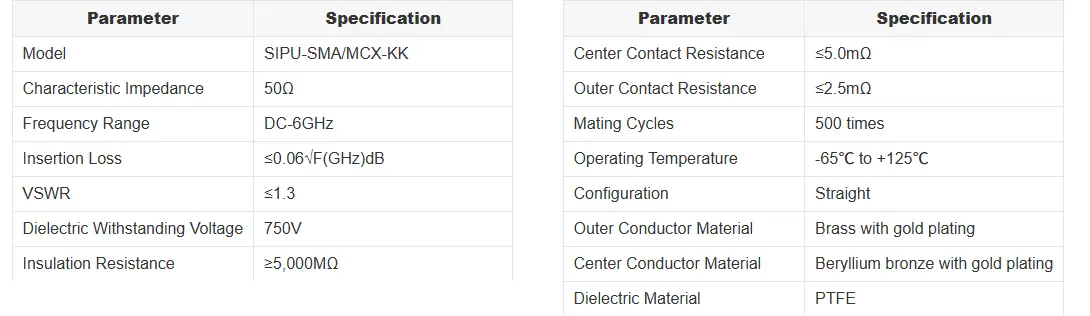
When you store qualification records for any SMA female to MCX female adapter, it's helpful to have a full parameter sheet. The SIPU-SMA/MCX-KK has the following electrical specs:
| Parameter | SIPU-SMA/MCX-KK |
|---|---|
| Impedance | 50 Ω |
| Frequency range | DC to 6 GHz |
| Insertion loss | ≤0.06√F(GHz) dB |
| VSWR | ≤1.3 |
| Dielectric withstanding voltage | 750 V |
| Insulation resistance | ≥5,000 MΩ |
| Contact resistance (center / outer) | ≤5.0 mΩ / ≤2.5 mΩ |
These limits can be turned into real numbers. The most insertion loss that can happen at 1 GHz is 0.06 dB. It's about 0.15 dB at 6 GHz, since 0.06 times the square root of 6 is 0.147. With a VSWR of 1.3, the return loss is about 17.7 dB, which means that only about 2% of the power that comes in is reflected at the interface. Check these limits against the amount you set for measurement error.
Materials and Gold Plating
The brass on the outside is gold-plated, and the beryllium bronze in the middle is also gold-plated. The insulator is made of PTFE. Gold doesn't rust and has low contact resistance, while beryllium bronze keeps its spring tension even after being mated many times. A "gold-plated" sign doesn't tell you much about quality by itself because the amount of the plating and the base metal work together. Sipu uses CNC machines to make parts, and then we test each batch to make sure the metal is thick enough, the finish sticks well, and it meets RoHS requirements. There is a clear acceptance line for an SMA female to MCX female adapter between ≤5.0 mΩ in the middle and ≤2.5 mΩ on the outside for labs that measure contact resistance.
Mechanical and Temperature Ratings
This SMA female to MCX female adapter can be mated 500 times, which is good for tables where the same port is attached a lot of times a week. From -65 °C to +125 °C, it can work, so you can put it in a thermal chamber with the thing you want to test. The PTFE dielectric works the same way all the way through that range. The small, straight body fits into racks and boards that are already full. Because contact wear is a common cause of drift in repeat measurements, I think you should write down each connection and replace the adapter when it reaches its rated limit. The number 500 cycles gives you a clear replacement schedule so you don't have to guess.
Applications of SMA Female to MCX Female Adapters
Test and Measurement Benches
An SMA female to MCX female adapter is used in RF labs to connect small test devices to standard instruments like vector network analyzers and spectrum analyzers. I either calibrate at the adapter's reference plane or "de-embed" its response when I set up a measurement. This way, the adapter doesn't add any hidden error. When this happens, it's most important that the same adapter, tightened the same way, always gives back the same trace. A lot of sub-6 GHz radios, IoT modules, and GNSS devices work in the DC to 6 GHz band. Similar adapters are also helpful for stations on a production line because they make sure that all of the stations see the same interface.
Telecommunications, 5G, and IoT
MCX ports are often on the board of small wireless modules, while SMA ports are used for external antennas and cables. Teams can test, tune, and deploy without having to make their own cable assemblies with this SMA female to MCX female adapter. Small-cell, distributed antenna, smart-city, and industrial IoT gear that works between DC and 6 GHz can use it. In that area are cellphone bands, WiFi bands between 2.4 GHz and 5 GHz, and many 5G bands below 6 GHz. If you need to work with millimeter waves, you should pick a different interface above 6 GHz. Before you order, make sure that your band does not go over 6 GHz.
GNSS, Industrial, and Field Maintenance
GNSS signals are between 1.1 and 1.6 GHz, which is well below the 6 GHz limit. This means that an SMA female to MCX female adapter can connect small navigation units to normal antenna feeds in test sets for the aerospace and car industries. MCX-equipped wireless devices can also be paired with external SMA antennas in industrial control systems. Service teams carry the adapter in service kits so that they can quickly swap them out. It can handle 500 cycles and temperatures between -65 °C and +125 °C, so it can be re-matted often on rough sites. Check the 50 Ω match first, because no matter how good the adapter is, a system that isn't matched will reflect some of the signal.
How to Choose the Right SMA Female to MCX Female Adapter
Start with the Mating Interfaces
Before you read the name of any SMA female to MCX female adapter, read the number of the connector on both devices. One side needs an SMA male plug, and the other side needs an MCX male plug. Next, make sure that the full RF system has the same resistance, frequency range, VSWR, return loss, and insertion loss. The SIPU-SMA/MCX-KK has a straight body and a 50 Ω range from DC to 6 GHz. Power handling isn't on the list of specs above, so let us know what your power level is if it's higher than low-level test signals. Then look at the materials, compliance documents, sample availability, minimum order quantity, lead time, and consistency of the batch.
Compare Variants Side by Side
Adapters that look alike have different ways of mating, so I start by comparing the interface details. If your ports don't match, an SMA female to MCX female adapter won't work in place of an SMA male to MCX female or an MCX male to SMA female adapter. Straight models are good for use in lines, right-angle models keep cables from getting tangled in small spaces, and bulkhead models mount through a panel. Plating in gold is best for resistance to corrosion and repeated mating, while plating in nickel is cheaper and better for light duty. Another thing that divides the field is its impedance. For GPS, wifi, cellular, and test systems, 50 Ω is normal, while 75 Ω parts are used for other things.
Common Problems and How to Avoid Them
When something goes wrong with an SMA female to MCX female adapter, it usually starts with the order. People often make mistakes like buying the wrong gender, not doing the impedance check, picking based only on price, and not checking the mechanical clearance. These mistakes lead to bad joining, more reflection, high VSWR, signal loss, or connection failure before it should. If you use a cheap adapter with bad VSWR, it can mess up a measurement and lead you to look for a problem that doesn't exist. You should look at the product code, drawing, and center-contact style before you place your order. Ask for samples of new projects and a datasheet, plating information, and inspection records so that your engineering team can sign off on the part in writing.
Sourcing and Verifying an SMA Female to MCX Female Adapter
Working with a Manufacturer or Supplier
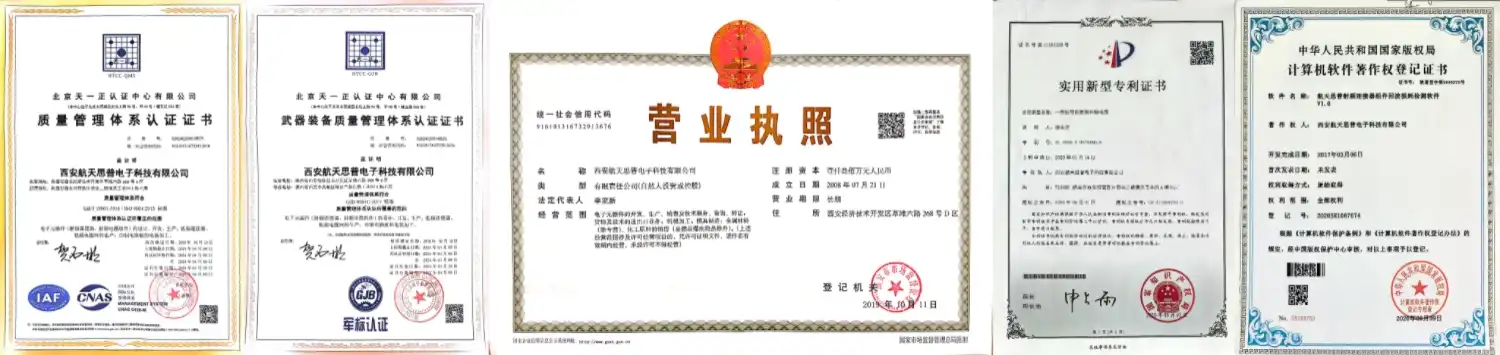
Sipu RF Technology has been making SMA female to MCX female adapters since 1998. The company is based in Xi'an, China. RF connectors, adapters, and wire kits that meet MIL, GJB, and IEC standards are what we make. Our quality system is ISO 9001 certified. We offer prototype samples, mass production, and OEM and ODM customization of materials, mechanical design, and electrical performance. Our engineers help you choose the right products and give you expert support. We answer all questions within 12 hours. In North America, our partner JNP Supplies LLC in Seattle, Washington, helps people in the US and Canada talk to each other and work together on projects. That mix works well for both short-term spare parts sales and long-term output plans.
Price, Availability, and Bulk Purchasing
The price is based on the materials, plating, testing, tolerances, order quantity, and packaging. Standard items are sent out within 72 hours of confirmation of the order, which works for quick repairs, making prototypes, and restocking spare parts once a year. If you buy fifty or one SMA female to MCX female adapter, I suggest that you stick to one part number and keep track of the lots so that each batch matches the last one. A good quote includes the amount, the Incoterms, the delivery time, the warranty, the labeling, and the paperwork. If you need a compliance pack, you should ask for the specific declarations, like RoHS and REACH, and compare the words on the retail packaging to those. When you buy from the manufacturer, you can find datasheets and engineering answers all in one place.
Technical Verification Before Installation
Before installing, check each SMA female to MCX female adapter to make sure that both of the connections fit together smoothly and without too much force. Center-pin alignment, thread condition, and full seating should all be checked. For a setting that needs to work well, use a vector network analyzer to check the adapter's VSWR and insertion loss across the frequency range you want to use it. Then, compare these numbers to the limits given in the datasheet. Keep track of the lot number along with the answer. Don't twist the wire or load the connector from the side; instead, use the suggested torque on the SMA side. Keep an eye out for signs of damage or wear during service, such as looseness, corrosion, signal loss that comes and goes, or rising VSWR.
Conclusion
There are specific details that can be used to measure the value of an SMA female to MCX female adapter. It is a passive 50 Ω link between a threaded SMA interface and a snap-on MCX interface. The SIPU-SMA/MCX-KK works from DC to 6 GHz and has an insertion loss of ≤0.06√F(GHz) dB, a VSWR of ≤1.3, and an insulation resistance of ≥5,000 MΩ. It has 500-cycle rating, gold-plated brass and beryllium bronze contacts, and a temperature range of -65 °C to +125 °C, so it can be used in test benches, telecom and IoT hardware, GNSS equipment, and field maintenance. It's more important to match the gender, resistance, and frequency to the system than the name of the product. Written specs, supplier paperwork, and a network analyzer check before use help buyers stay away from reflection mistakes, ordering the wrong part, and drift between batches.
FAQ
1. What frequency range does the SIPU-SMA/MCX-KK support?
It works from DC to 6 GHz and has a VSWR of ≤1.3 and an insertion loss of ≤0.06√F(GHz) dB. That range includes GNSS, WiFi, and cellphone bands.
2. How many mating cycles does it handle, and at what temperatures?
It can work from -65 °C to +125 °C and is rated for 500 mating cycles. This makes it good for testing in a thermal chamber. To get the same results every time, replace the SMA female to MCX female adapter at the recommended limit.
3. Can I use it in a 75 Ω system?
It's not meant to work with a 75 Ω system because the impedances wouldn't meet, and the signal would be reflected.
4. What materials does it use?
A gold-plated brass conductor runs along the outside, a gold-plated beryllium bronze conductor runs through the middle, and PTFE acts as a dielectric.
5. How fast do standard products ship?
Standard items are sent out 72 hours after an order is confirmed.
6. Does SIPU help me choose an SMA female to MCX female adapter?
Yes. If you need help choosing, using, or fixing something, our engineers are here to help. You can also look at samples to see what they're like.
Request a Quote for the SIPU SMA Female to MCX Female Adapter
After an order is confirmed, SIPU ships standard items within 72 hours. To find a supplier of an SMA female to MCX female adapter for lab supplies, repair kits, or a production line, email info@sipu-rf.com with the number of adapters you need, where you want them sent, and what kind of paperwork you need. For the SIPU SMA female to MCX female adapter, ask for a specification, a sample, or a price quote. Our engineers will get back to you within 12 hours, and you can see all of our connectors at sipuconn.com.
References
1. IEC 61169-15: Radio-frequency connectors – Part 15: Sectional specification for rf coaxial connectors with screw coupling, characteristic impedance 50 ohms (type SMA), 2012.
2. Pozar, D. M. Microwave Engineering, 4th Edition, Wiley, 2011.
3. Hewlett-Packard. Understanding the Fundamental Principles of Vector Network Analysis, Application Note 1287-1, 1997.
4. European Parliament and Council. Directive 2011/65/EU on the restriction of the use of certain hazardous substances in electrical and electronic equipment (RoHS), 2011.
5. European Parliament and Council. Regulation (EC) No 1907/2006 on the Registration, Evaluation, Authorisation and Restriction of Chemicals (REACH), 2006.
6. International Organization for Standardization. ISO 9001: Quality management systems – Requirements, 2015.
Contact us directly for customized solutions, quotations and long-term strategic cooperation.